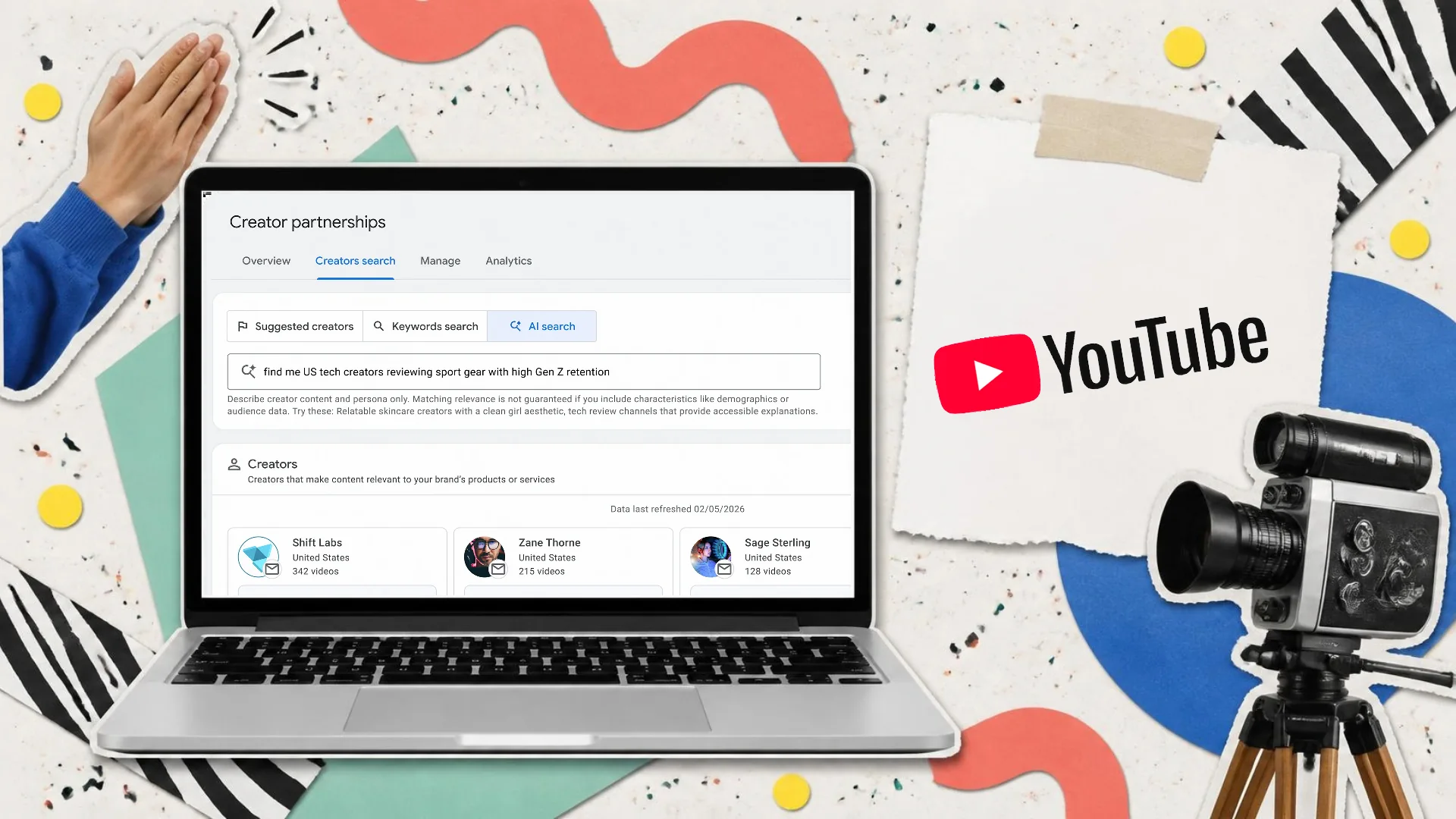
YouTube has had a tool for brand deals since it bought FameBit in 2016. It was called BrandConnect, and for most Gulf agencies it was out of reach. On 23 March 2026 YouTube relaunched it as YouTube Creator Partnerships, renamed its partnership ads as creator partnerships boost, and over the following months opened it up. For agencies that book creators in the region, it is now worth knowing properly.
What Creator Partnerships includes
- Creator discovery powered by Gemini, searching more than three million creators in the YouTube Partner Program.
- Outreach to several creators at once, and a place to manage brand deal links.
- Brand Lift, Search Lift and Conversion Lift studies to measure a campaign.
- Access to a creator's video performance, organic and paid, once the creator shares it.
- An API for selected partners.
Availability in the Gulf
This is where 2026 changed things. Google's help page says that since June 2026 the brand-side tools, including creator search, lists and the overview, are available in every country where the YouTube Partner Program is active. That list includes the UAE and Saudi Arabia, as well as Bahrain, Kuwait, Oman, Qatar, Jordan and Egypt. Advertisers need an active Google Ads account registered in one of those countries; the old minimum spend, and the need to work with a Google sales team, no longer apply.
On the creator side, YouTube's help page lists 24 countries where creators can use Creator Partnerships, including the UAE and Saudi Arabia. Creators must be 18 or over, in the Partner Program, and free of active Community Guidelines strikes. YouTube's own count of markets has changed several times, from seven at launch to 20 in September, so check the current help pages rather than any article, including this one.
Open Call, where a brand posts a brief and creators submit Shorts, is still limited to creators in the US, the UK and India. YouTube said in November 2025 that it would come to the Middle East in 2026; it had not arrived when we checked.
Boosting a creator's video
Creator partnerships boost runs a creator's organic video as an ad from the brand's Google Ads account. The creator links the video to the brand, it appears in a Received tab, and the brand can use it in Demand Gen, Video reach, Video views, App and Performance Max campaigns. The co-branded format that shows both names is narrower: Demand Gen in the feed and Shorts, Video reach and Video views in Shorts, the feed and on TV screens, and App campaigns on iOS only. Since May 2026 creator videos can be boosted straight from the asset picker when building a Demand Gen campaign, where Google's AI suggests which to use.
Google's help page is explicit that the brand must secure the rights to use a creator's video as an ad, which may need a separate agreement. Linking a video in the tool is not a licence.
The numbers, used correctly
YouTube says advertisers who boosted creator-led videos on Shorts saw an average 30 percent increase in conversion lift, and that creator partnerships boost in Demand Gen gave an average 20 percent increase while keeping to target cost per action. Both come from Google's global data from January 2025 to January 2026. Trade coverage often swaps them: 30 is Shorts, 20 is Demand Gen.
What was announced in September
At Made on YouTube on 23 September 2026, YouTube added a one-click code for creators to share a video's performance with a brand, and announced dynamic brand segments, which will let a brand's segment be inserted into up to 20 of a creator's long videos at once, targeted by region, with a call-to-action shelf. It gave no date for those. It also said it is investing hundreds of millions of dollars in incentives for agency partners, and that Ask Studio, its AI assistant for creators, will help them respond to brand briefs.
Disclosure and the contract
Creators must tick the paid promotion box on sponsored videos, and viewers then see a disclosure at the start. When a creator shares performance access with a brand, YouTube adds the paid promotion label automatically. YouTube's page names regulators such as the FTC and the ASA but not Gulf ones, so local rules still apply on top: in the UAE, a creator publishing advertising also needs the advertiser permit.
A contract for a YouTube creator deal should now cover:
- Paid usage: whether the brand may boost the video, on which campaign types, for how long and in which countries.
- Performance access: that the creator will share the video's data through YouTube's tool.
- Disclosure: the paid promotion setting, and the UAE permit where it applies.
- Edits: whether the brand may cut the video for ads, and who approves the cut.
The free YouTube engagement rate calculator on this site shows how many of a channel's subscribers actually watch, like and comment, and the influencer rate calculator gives a starting point for the fee.