Saudi Arabia started e-invoicing in December 2021. The UAE's first businesses go live in January 2027. Agencies working in both countries hear the same words, XML, e-invoice and provider among them, and assume one setup covers both. It does not.
Saudi Arabia: FATOORA
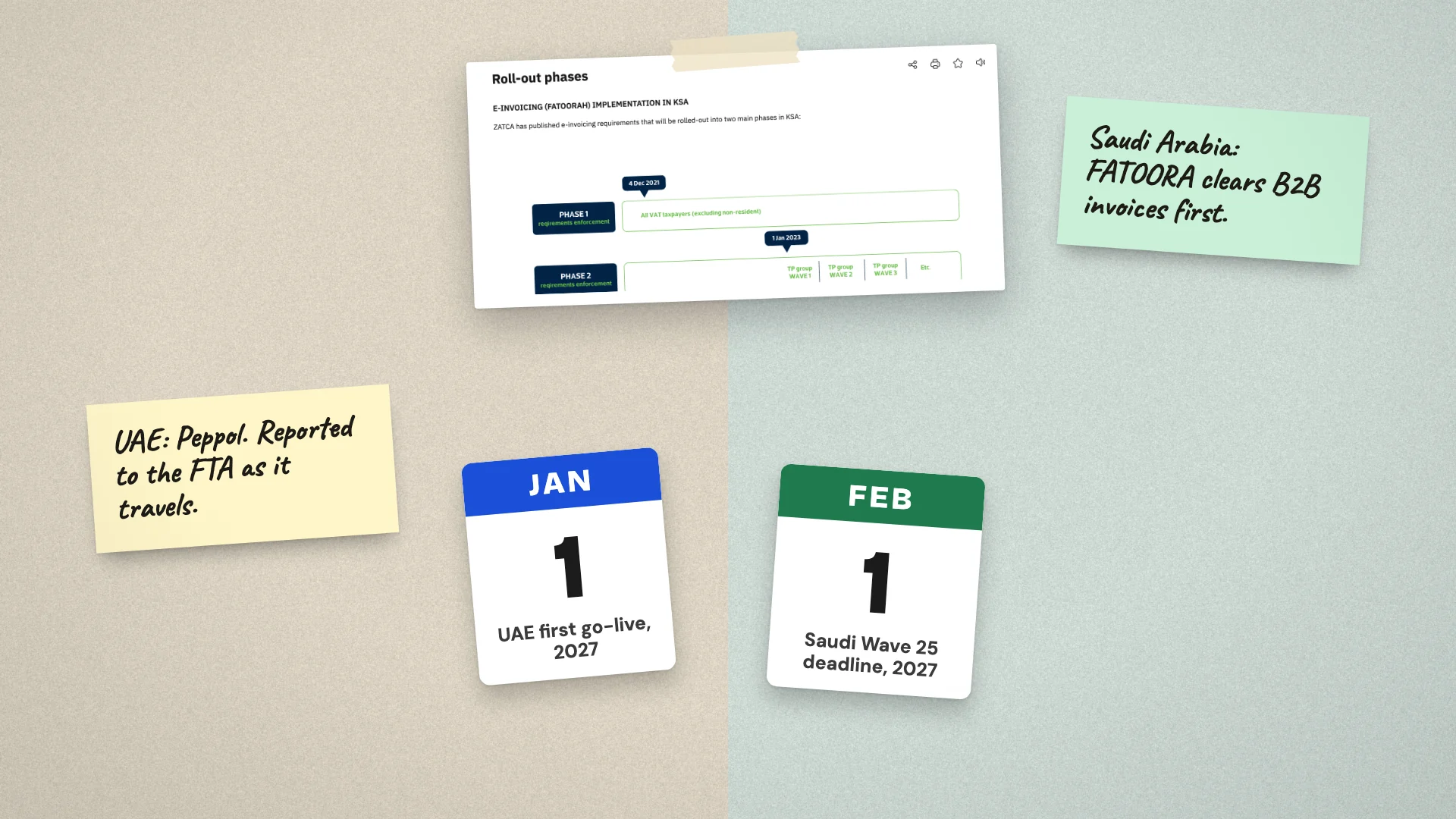
- Phase 1, generation, has applied since 4 December 2021 to all VAT taxpayers except non-residents.
- Phase 2, integration with ZATCA's FATOORA platform, began on 1 January 2023 in waves, each announced at least six months ahead. Wave 25, announced on 24 July 2026, covers taxpayers with VAT-able revenue above SAR 187,500 in any year from 2022 to 2025, who must integrate by 1 February 2027.
- Standard tax invoices, mostly business to business, must be cleared by FATOORA before they reach the buyer. FATOORA adds a cryptographic stamp and a QR code.
- Simplified invoices, mostly to consumers, are stamped by the seller's own system, carry a QR code and are reported within 24 hours.
- Invoices are UBL 2.1 XML. Buyers can receive the XML or a PDF/A-3 with the XML inside.
The UAE: Peppol
- The UAE does not clear invoices. Its five-corner model sends each invoice from your accredited provider to your client's provider over Peppol, and reports the tax data to the FTA in parallel.
- There is no QR code or cryptographic stamp. The provider gives each invoice a unique identifier.
- The format is PINT AE, a Peppol specification that also uses UBL.
- Businesses with revenue of AED 50 million or more go live on 1 January 2027, the rest on 1 July 2027. Sales to consumers are out for now.
The differences that matter
- Before or after. A Saudi B2B invoice is not valid until it is cleared. A UAE e-invoice is validated by the providers and reported as it moves.
- Who is in. ZATCA's guideline says taxable persons who are not resident in Saudi Arabia are not required to issue e-invoices. UAE e-invoicing covers anyone conducting business in the UAE, registered for VAT or not.
- Identity. The UAE uses your 10-digit Tax Identification Number on Peppol. Saudi Arabia uses your VAT number on FATOORA.
- Systems. A Saudi entity needs a solution onboarded to FATOORA, with device certificates issued by ZATCA. A UAE entity needs an accredited service provider. Neither covers the other.
Billing a Saudi client from the UAE
A UAE agency invoicing a Saudi company from the UAE does not issue a ZATCA e-invoice, because it is not resident in Saudi Arabia. On the UAE side it issues a PINT AE export e-invoice, with the export flag and the placeholder address 0235:9900000099, zero-rated if the export tests are met. The UAE does not currently recognise Saudi Arabia as an implementing state under the GCC VAT agreement, so a Saudi client is treated like any other foreign client. Vendor guides say the Saudi buyer normally accounts for Saudi VAT under the reverse charge. We could not check that against ZATCA's own text, so confirm it with your client or a Saudi adviser.
If you have entities in both countries
- Run two registrations and two systems: FATOORA integration in Saudi Arabia and an accredited provider in the UAE.
- Keep client records per country. The same client may need a Saudi VAT number on Saudi invoices and the export placeholder on UAE ones.
- Watch both calendars. Wave 25's 1 February 2027 deadline lands a month after the UAE's first go-live.
Penalties
- Saudi Arabia: ZATCA's 2021 announcement put fines for not issuing e-invoices from SAR 5,000, and for deleting or amending them from SAR 10,000, rising for repeat violations.
- The UAE: AED 100 for each e-invoice not issued on time, up to AED 5,000 a month, and AED 5,000 a month for failing to implement the system.
The VAT calculator on this site handles UAE VAT at 5% for a quick check on any amount.