When people talk about e-invoicing they usually mean the invoices they send. But the same accredited service provider receives the invoices your suppliers send you: the printer, the production house, the venue, the freelancer with a trade licence. The Ministry of Finance's guidelines say a business appoints one provider for both sending and receiving.
How a supplier's e-invoice reaches you
Your supplier's provider delivers the invoice over the Peppol network to yours. Your provider validates it and reports its tax data to the Federal Tax Authority. If it fails validation, your provider sends a rejection to the supplier's provider and to the FTA, and nothing is reported. What you receive is a structured file, which your accounting software can read instead of someone retyping a PDF.
The input VAT rules
- Article 55 of the VAT Decree-Law lets you deduct input VAT in the first tax period in which you hold the tax invoice and have paid it, or intend to pay it within six months of the agreed date.
- Since October 2024 there is a further condition: where an invoice must be issued as an e-invoice, or has been, you keep it in line with the e-invoicing system.
- If you miss the first period, you can claim in the next one. After that, the FTA expects a voluntary disclosure.
- The five-year limit that took effect on 1 January 2026 applies to using or refunding a VAT credit balance, not to claiming input VAT. A credit from the January 2026 period lapses on 31 January 2031.
The transition
Until a supplier's own phase goes live, its tax invoices follow today's rules, and a PDF tax invoice is the document you rely on. If a supplier is live and you are not, it sends the e-invoice to a placeholder address and gives you a regular invoice, such as a PDF, as well. The e-invoicing condition only applies where an e-invoice is required or was issued, so on our reading a PDF from a supplier that is not yet live still supports your claim. The FTA has not published guidance on the in-between case.
Ad platforms and other imported services
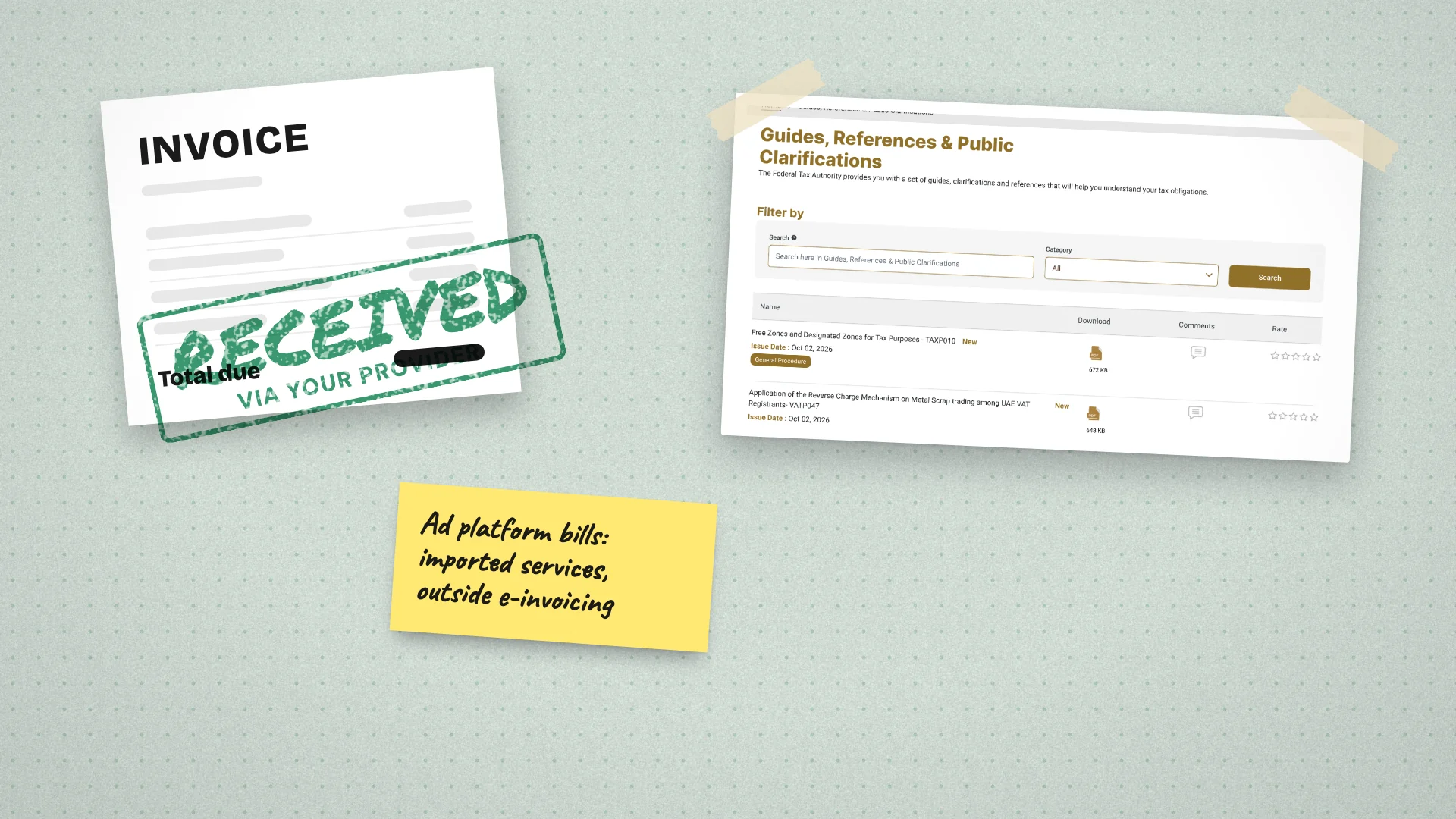
Bills from Meta, foreign freelancers or overseas software are imported services under the reverse charge. The guidelines say imports of these services are not subject to any e-invoicing requirements. Since 1 January 2026 you no longer issue yourself a self-invoice for them: you account for the VAT in boxes 3 and 10 of your return and keep the supplier's invoice. The reverse charge category on e-invoices is for certain domestic goods, such as electronics and scrap metal, not for ad platform bills.
New checks on suppliers
Since 1 January 2026 the FTA can deny input VAT where a supply is part of a tax evasion chain and you knew, or should have known. Not checking a supplier counts as should have known. FTA Decision 13 of 2026, in force since 1 October 2026, sets out the checks:
- Verify each supplier's identity, incorporation and address, and look for risk flags.
- For suppliers above AED 375,000 in 12 months, also get a UAE bank's confirmation of their account and look at public reviews or coverage.
- Pay electronically, document the checks, keep a written policy and re-verify suppliers every 12 months.
- Supplies under AED 10,000 are outside the checks, unless that supplier exceeds AED 100,000 a year.
Cabinet Decision 149 of 2026, also in force from 1 October 2026, blocks input VAT on supplies paid in cash above a value the Minister will set. As of early October we could not find that value published.
What to do now
- When you compare providers, ask how received invoices reach your accounting software.
- Tell your provider within five business days of any change to your registered details. The penalty is AED 1,000 a day.
- Ask your regular suppliers which phase they are in and when their e-invoices will start.
- Write down your supplier checks now. They already apply, e-invoicing or not.
Suppliers fix errors on their side by issuing an electronic credit note, not by editing the invoice. The VAT calculator on this site splits any amount into its net and VAT parts when you check a supplier's figures.