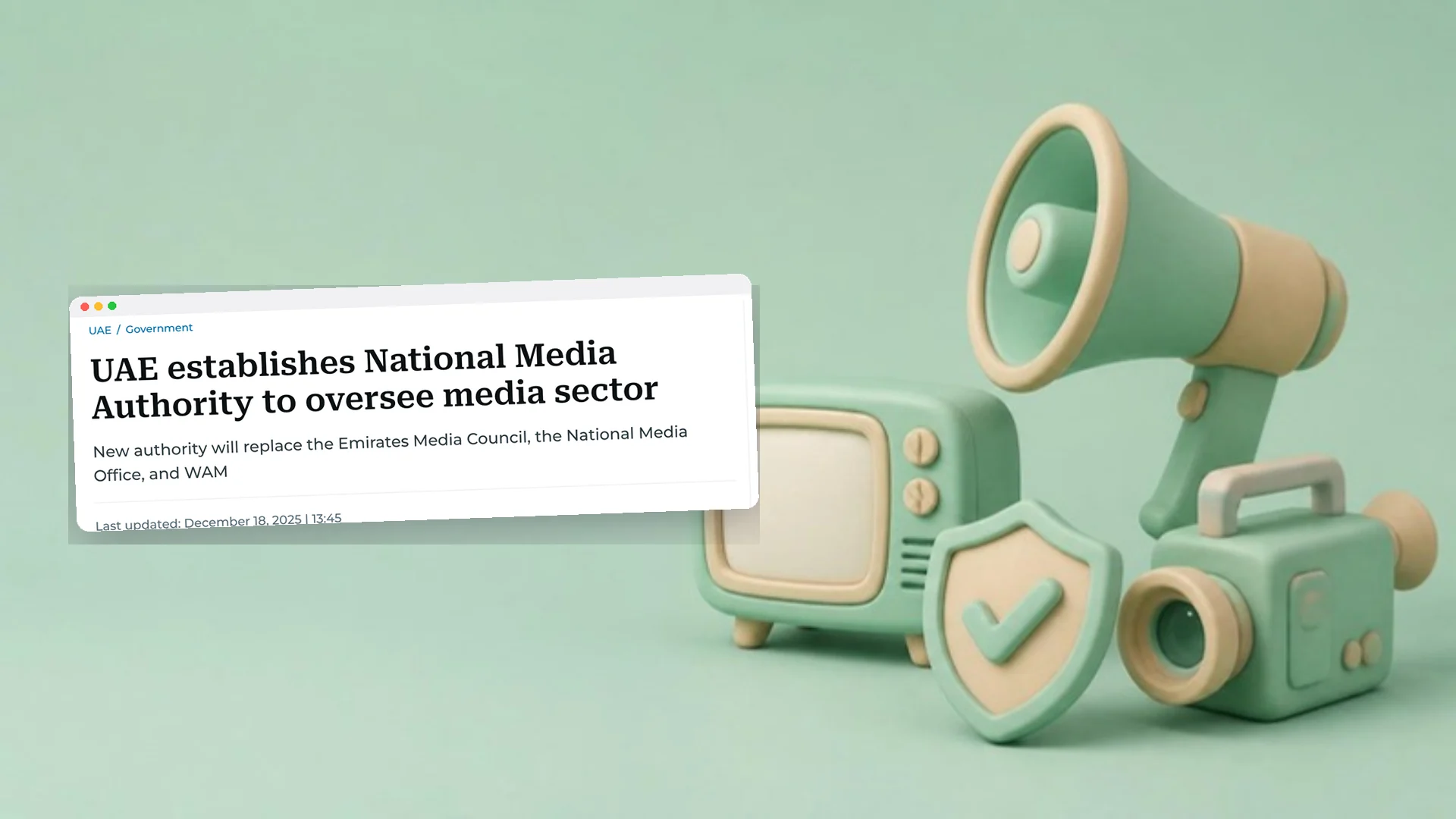
If your contracts, creator briefs or onboarding checklists still name the UAE Media Council, they are out of date. On 18 December 2025 the UAE Government announced a Federal Decree-Law creating the National Media Authority, a federal body that reports to the Cabinet and has its own finances and administration. It took over all the functions, rights and obligations of three bodies:
- The UAE Media Council, which ran media licensing and the influencer rules.
- The National Media Office.
- The Emirates News Agency, WAM.
Who runs it
On 6 January 2026 the UAE President, Sheikh Mohamed bin Zayed, appointed Abdulla bin Mohammed bin Butti Al Hamed as chairman of the authority. He previously chaired both the UAE Media Council and the National Media Office, so the leadership carries over. Mohammed Saeed Al Shehhi was appointed vice chairman.
What it does
According to the announcement, the authority proposes the rules for licensing all media outlets and media activities, including digital media and publishing. It sets content standards and monitors what is published, printed or broadcast, including in free zones, and it accredits media professionals. Free zone businesses sometimes assume media rules stop at the free zone boundary. On content, they do not.
The law behind it
The authority's advertising powers come through the UAE media law, Federal Decree-Law No. 55 of 2023 on media regulation. Its penalties regime, Cabinet Resolution No. 42 of 2025, took effect on 29 May 2025.
- There are 20 mandatory content standards, and advertising is among them.
- Fines run up to one million dirhams, and up to two million for repeat violations.
- General breaches, such as operating without a licence or breaking advertising rules, carry fines of 5,000 to 40,000 dirhams, according to Gulf News and Khaleej Times.
The Advertiser Permit
Anyone promoting goods or services on social media in the UAE, paid or unpaid, has needed an Advertiser Permit since 1 February 2026, after a grace period that ran to 31 January. It is free for citizens and residents for the first three years and valid for a year at a time. Visitors get a three-month permit through licensed UAE agencies. People promoting their own business on their own account, and under-18s making educational content, are exempt. Gulf News and the law firm Pinsent Masons report fines of 10,000 dirhams for advertising without a permit, rising to 40,000 for a repeat offence.
What it has said lately
On 29 September 2026 the authority said on its social media channels that using AI to generate images or videos of national symbols or public figures requires prior official approval, and that using AI for misinformation, defamation or attacks on social values is a media violation punishable by fines and administrative penalties. The UAE Media Council issued a very similar warning in September 2025, so this is the new authority restating a rule rather than inventing one, but the timing ahead of National Day matters.
The authority is also running a 2026 national campaign to raise awareness of media content standards, and it enforces the new limits on children's social media accounts together with the telecoms regulator.
What agencies should update
- Replace references to the UAE Media Council in contracts, briefs and creator guides with the National Media Authority.
- Record every UAE creator's Advertiser Permit number and expiry date against the contract, and recheck it at renewal.
- Add the AI rule to briefs: no AI-generated images or video of national symbols or public figures without approval obtained first.
- Treat disclosure as a standard, not a courtesy. Advertising rules sit inside the 20 content standards.
- If the agency runs its own media, such as a podcast, a newsletter or a publication, ask your licensing authority whether it needs a media licence.
The influencer disclosure checker on this site reviews a caption for a clear paid partnership label before it goes live.