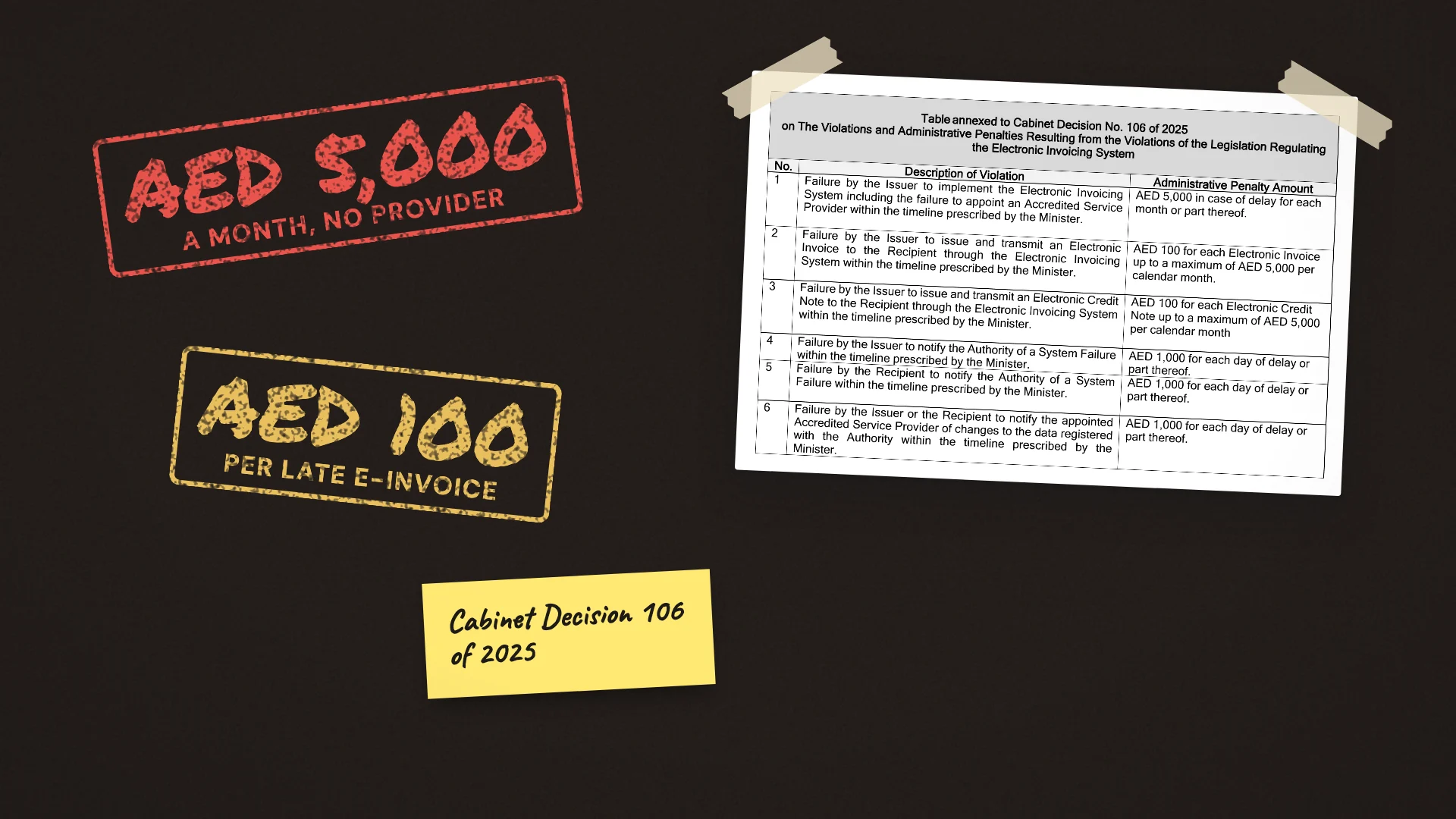
When we wrote about the e-invoicing deadline earlier this month, we could not check the penalty amounts against the decision itself. We have since read the Ministry of Finance's English text of Cabinet Decision 106 of 2025, announced on 8 December 2025. Its table has six lines.
The six penalties
- Failing to implement the e-invoicing system, including failing to appoint an accredited service provider on time: AED 5,000 for each month or part of a month of delay.
- Failing to issue and send an e-invoice to the recipient through the system on time: AED 100 for each e-invoice, up to AED 5,000 per calendar month.
- Failing to issue and send an electronic credit note through the system on time: AED 100 for each credit note, up to AED 5,000 per calendar month.
- Failing, as the issuer, to tell the FTA about a system failure on time: AED 1,000 for each day or part of a day.
- Failing, as the recipient, to tell the FTA about a system failure on time: AED 1,000 for each day or part of a day.
- Failing, as issuer or recipient, to tell your accredited provider about changes to your data registered with the FTA on time: AED 1,000 for each day or part of a day.
The deadlines behind them
- Appointing a provider and going live: 30 October 2026 and 1 January 2027 for revenue of AED 50 million or more, 31 March 2027 and 1 July 2027 for everyone else, and 31 March and 1 October 2027 for government entities.
- Issuing an e-invoice: within the VAT invoice timeline if you are VAT registered, or within 14 days of the transaction if not.
- Issuing a credit note: within 14 days of the event that requires it.
- Reporting a system failure to the FTA: within two business days.
- Updating your provider after a change to your registered details: within five business days of the FTA confirming the change.
How to read the table
- There is no escalation for repeat offences. The invoice line and the credit note line each have their own monthly cap, and the text does not say whether the two caps add together.
- The penalties do not apply to businesses using the system voluntarily, and the guidelines say they apply only from your own mandatory date.
- The last line is about telling your provider, not the FTA. The two system failure lines are about the FTA.
- Some summaries describe a fine for invoices not issued in the required format. The decision's wording is about issuing and sending within the timeline.
- Existing VAT penalties under Cabinet Decision 40 of 2017 can still apply to the same invoice.
When it takes effect
The decision comes into force the day after its publication in the Official Gazette. We could not confirm the publication date. In practice the penalties are tied to each business's mandatory dates, so the first that can bite are for businesses with revenue of AED 50 million or more that have not appointed a provider by 30 October 2026.
What it means for a small agency
For an agency in the second phase the exposure is easy to size. Missing the 31 March 2027 appointment date costs AED 5,000 for each month or part of a month. From 1 July 2027, each invoice or credit note issued late, or outside the system, costs AED 100, up to AED 5,000 a month for each kind. None of it is large on its own, but it repeats every month until the system is in place.
The working days calculator on this site counts business days between two dates, which helps with the two-day and five-day notice periods.