Plenty of UAE agencies bill clients abroad: a brand in London, a group in Riyadh, a start-up in Singapore. Under e-invoicing those invoices do not sit outside the system. The Ministry of Finance's guidelines say an export tax invoice should be issued as an electronic invoice, and the Ministry's own worked example is a UAE IT firm invoicing a client in France.
When the invoice is zero-rated
Article 45 of the VAT Decree-Law zero-rates exported services, and Article 31 of the Executive Regulation, as amended in November 2024, sets the tests. For an agency, the usual route needs all three of these:
- The client has no place of residence in the UAE or another implementing state, and is outside the UAE when the services are performed. A visit of less than 30 days that is not connected with the work does not count.
- The services are not directly connected with UAE real estate or with goods located in the UAE.
- The services are not ones the law treats as performed in the UAE. That list includes cultural, artistic, sporting, educational and similar services, which can catch events and shoots that take place here.
Services performed entirely outside the UAE can qualify by a separate route.
Where zero-rating fails
- The client's representative is in the UAE while you do the work. The FTA's guidance on exported services, VATP019, says zero-rating is then lost.
- The client has a UAE branch that is more closely connected with the work. The client then counts as UAE resident.
- Someone in the UAE, such as the client's local staff, will foreseeably receive the service and could not recover the VAT in full.
- You cannot establish the facts. In that case the FTA says you must standard-rate the supply, so keep the evidence: contracts, addresses and where the client was during the work.
Gulf clients
A client in Saudi Arabia, Oman or Kuwait is treated like any other foreign client today. The FTA does not recognise any other GCC state as an implementing state, so the same tests apply and the same export invoice is used.
Foreign currency
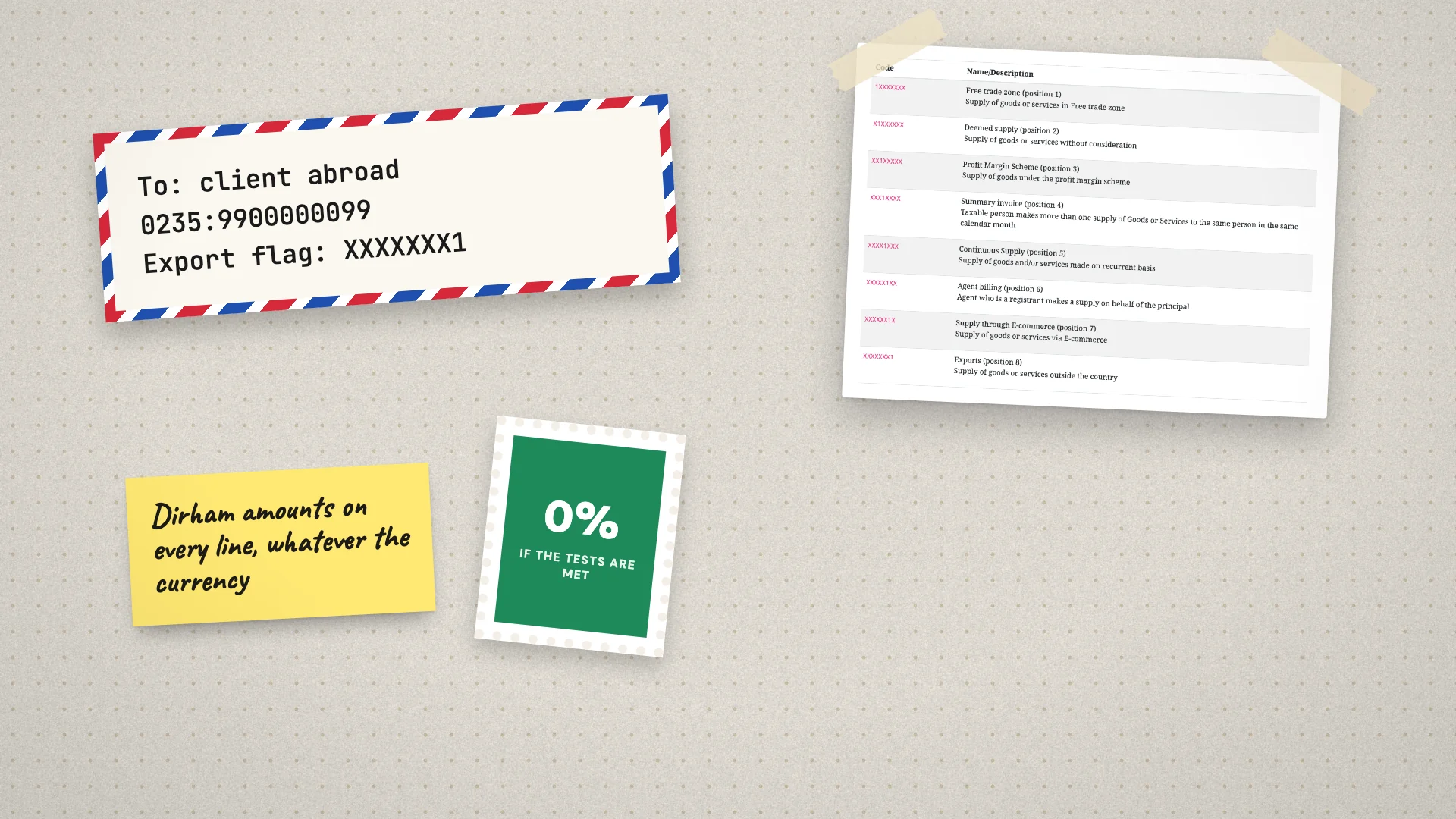
Article 69 of the Decree-Law says amounts on a tax invoice in another currency are converted into dirhams at the UAE Central Bank's rate on the date of supply. E-invoicing makes that concrete. Every line carries its dirham amount, the file states the exchange rate, and the VAT and the total with VAT are given in AED, whatever currency you bill in.
What changes in the file
- The export flag. The last of the invoice's eight transaction-type flags marks an export.
- A delivery address. With the export flag set, a delivery address outside the UAE becomes mandatory.
- A placeholder address. If the client has no Peppol ID, which is usual abroad, the invoice goes to 0235:9900000099. It is reported to the FTA, and the client receives their copy outside the network, usually by email.
- A full tax invoice. The old relief that let wholly zero-rated supplies go without a tax invoice does not apply to businesses invoicing electronically.
Buying from abroad
The other direction is simpler. Services you import, such as a foreign freelancer's invoice or your ad platform bills, fall under the reverse charge, and the guidelines say they are not subject to any e-invoicing requirements. Since 1 January 2026 you no longer have to issue yourself a self-invoice for them, although you still account for the VAT and keep the supplier's invoice.
The VAT calculator on this site works out the VAT on any amount, inclusive or exclusive, while you check how your foreign invoices are set up.