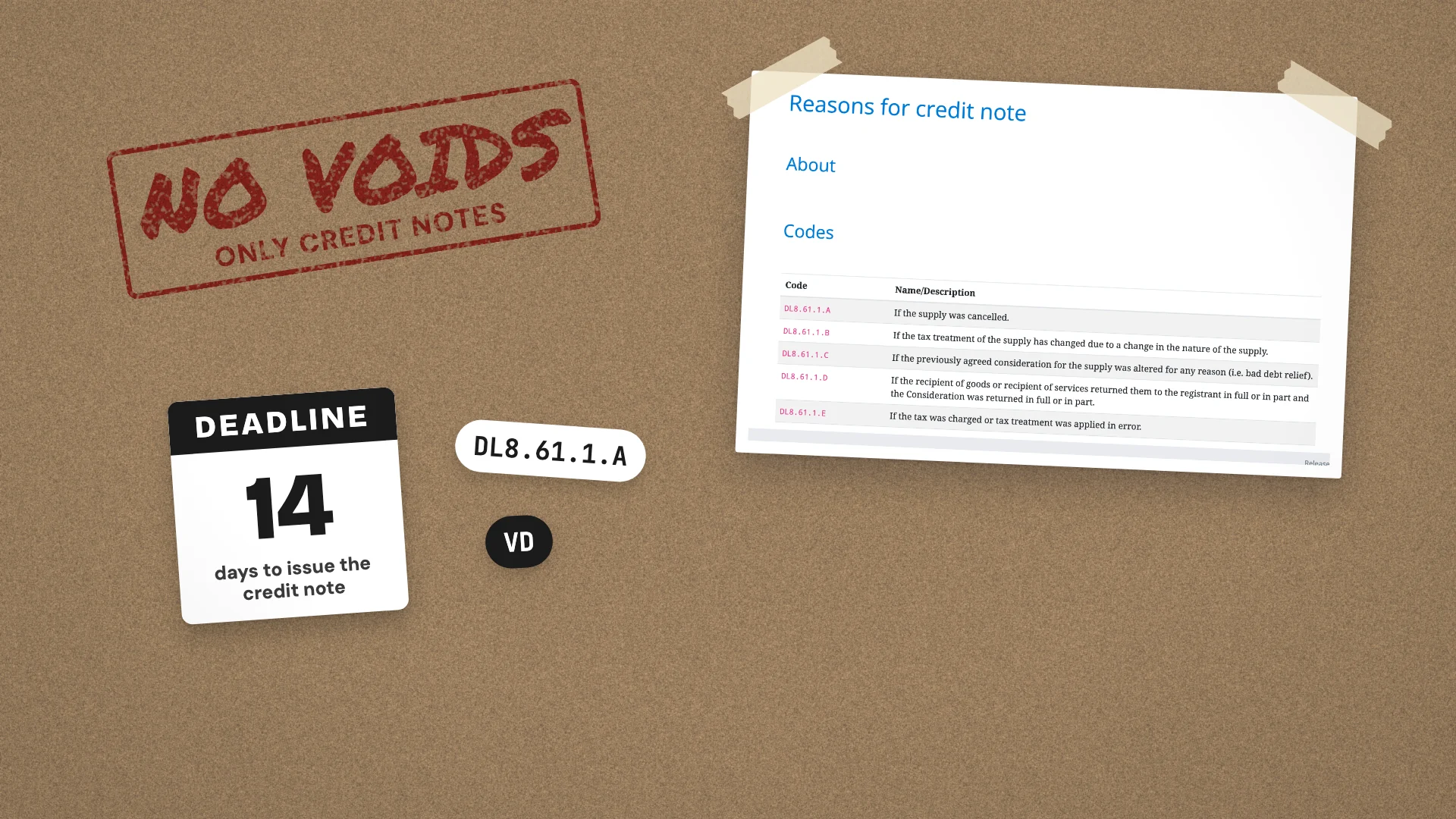
Plenty of agencies fix a wrong invoice by voiding it and issuing a new one. Under e-invoicing that option goes away. The Ministry of Finance's FAQ puts it plainly: "There is no concept of cancellation of an invoice." Once an e-invoice is issued, the only way to reverse or reduce it is an electronic credit note. Negative invoices are not allowed, and neither are debit notes: if the amount goes up, you issue a new tax invoice.
When a credit note is required
Ministerial Decision 243 of 2025 requires an electronic credit note when:
- the transaction is cancelled;
- the price is reduced;
- the money is returned, in full or in part;
- there is an administrative or numerical error.
The six reason codes
Every credit note carries a reason code. The codes in the PINT AE specification follow Article 61 of the VAT Decree-Law:
- DL8.61.1.A: the supply was cancelled. This is also the code for an invoice sent to the wrong customer.
- DL8.61.1.B: the tax treatment changed because the nature of the supply changed.
- DL8.61.1.C: the agreed price was changed for any reason.
- DL8.61.1.D: goods or services were returned and the money refunded in full or in part.
- DL8.61.1.E: tax was charged, or a tax treatment applied, in error.
- VD: a volume discount.
A credit note must also reference the invoice it corrects, except when the reason is a volume discount.
The 14-day rule
Article 62 of the VAT Decree-Law gives you 14 days from the event, whether a cancellation, a price change or a refund, to issue the tax credit note. Businesses that are in scope for e-invoicing but not registered for VAT get the same 14 days under Ministerial Decision 243. Each electronic credit note not issued on time costs AED 100, up to AED 5,000 a month.
Partial and combined credits
- A credit note can cover part of an invoice, such as a reduced fee or one cancelled deliverable.
- One credit note can reference several invoices.
- A provisional invoice is adjusted later with a credit note or an additional invoice.
What the credit note shows
Article 60 of the Executive Regulation still sets the particulars: the words Tax Credit Note clearly displayed, both parties' details and TRNs, the date, the reason, the tax in dirhams and enough information to identify the original supply. For an electronic credit note the before-and-after value comparison is no longer required, and in the PINT AE format a credit note does not need a payment method.
What to change now
- Stop voiding issued invoices out of habit. Keep voids for drafts that were never sent.
- Record why each credit note is raised, so the right reason code is chosen.
- Start the 14 days when the event happens, not when the paperwork is convenient.
- Ignore advice that an e-invoice can be cancelled within a set number of hours. That does not exist in the UAE.
Until your go-live date, credit notes follow today's rules, which already include the 14 days. The invoice generator on this site produces a tax invoice that meets the current requirements.