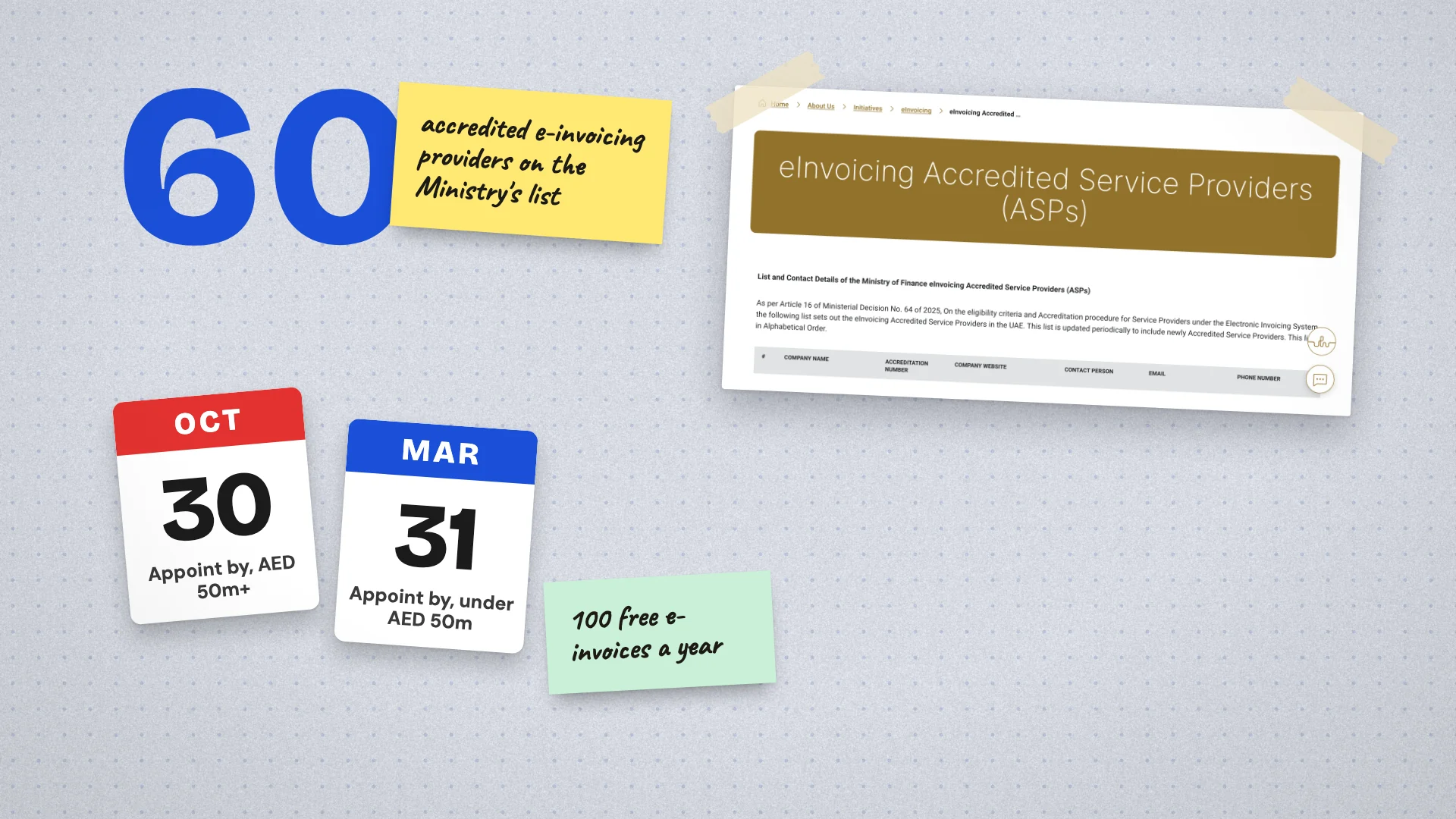
Under UAE e-invoicing, an invoice no longer goes straight from you to your client. It goes through an accredited service provider, known as an ASP, which checks it, delivers it over the Peppol network to your client's own provider, and reports the data to the Federal Tax Authority. Choosing that provider is the first real decision in the project. The Ministry of Finance's list showed 60 accredited providers in early October 2026, plus 6 pre-approved ones in their final assessment.
The deadlines
- Revenue of AED 50 million or more: appoint a provider by 30 October 2026 and go live on 1 January 2027.
- Revenue under AED 50 million: appoint a provider by 31 March 2027 and go live on 1 July 2027.
- Government entities: appoint by 31 March 2027 and go live on 1 October 2027.
Ministerial Resolution 66 of 2026 moved the first appointment date from 31 July to 30 October, but the Ministry's June 2026 guidelines and the timeline graphic on its website still show the old date. Revenue means gross income in your most recent accounting period, and the legal text says equal to or above 50 million, not exceeding it. Missing your deadline, including not appointing a provider, carries a penalty of AED 5,000 for each month or part of a month.
One provider for everything
The Ministry's e-invoicing guidelines say a business must appoint only one ASP, covering both the invoices it sends and the invoices it receives. You cannot use one provider for sales and another for purchases. In a tax group, each member may choose its own.
What the rules already guarantee
- 100 free e-invoices a year. To be accredited, a provider commits to 100 free e-invoice exchange and reporting services a year for each customer, counted from the date you sign. It can still charge for setup and integration, and the Ministry suggests writing the free allowance into your contract.
- A vetted provider. Accreditation requires Peppol certification, a UAE licence, ISO 27001 for the product and ISO 22301 for business continuity, minimum insurance cover and paid-up capital of at least AED 50,000. It lasts two years.
- A contract with the accredited company itself. Since May 2026 an accredited provider may run its service on an international partner's product, a white-label arrangement, but the Ministry's FAQ says a contract with a foreign head office or any other intermediary is not compliant.
The Ministry's checklist
In February 2026 the Ministry published a short guide, Considerations for selecting an Accredited Service Provider. Condensed, it asks you to check:
- Track record: years in e-invoicing, years as a Peppol provider and years operating in the UAE.
- The product: whether the provider owns it or uses a partner's, and whether support is in-house or subcontracted.
- Integration: whether it connects to your accounting software through an API or file formats you can actually use.
- Data: where your data is stored. There is no blanket rule that providers host in the UAE, but your own sector may require it.
- Security: certifications, encryption, access controls and how incidents are handled.
- Service: support response times and uptime commitments.
- Price: subscription or per invoice, the 100 free e-invoices, and any hidden fees.
- The future: whether it can grow with you, and its product roadmap.
Questions agencies should add
- How is the free allowance counted: per invoice sent, per invoice received, or both? A small agency may stay inside it.
- How does it handle credit notes, and invoices to clients abroad who are not on Peppol?
- How do you leave? There is no published procedure for switching providers beyond an offboarding step in EmaraTax, so ask how it works and how you get your records out.
Signing up
You start onboarding yourself, not the provider. In EmaraTax you open the e-invoicing tile, choose your provider and receive a Peppol ID based on your Tax Identification Number. Businesses with no FTA registration need to get that number first. After go-live, tell your provider within five business days whenever your registered details change, or face a penalty of AED 1,000 a day.
Until your own go-live date, today's tax invoice rules still apply. The invoice generator on this site produces a tax invoice that meets them.