An unpaid invoice is a cash flow problem long before it is a legal one. But when reminders stop working, UAE law gives agencies more tools than many realise, and several rules changed when the new Commercial Transactions Law took effect on 2 January 2023.
Before going legal
- Send a statement of account and a formal demand. Commercial demands can be served by notary, certified mail, an electronic method approved by the Justice Minister, or any method agreed in your contract (Article 81 of the Commercial Transactions Law).
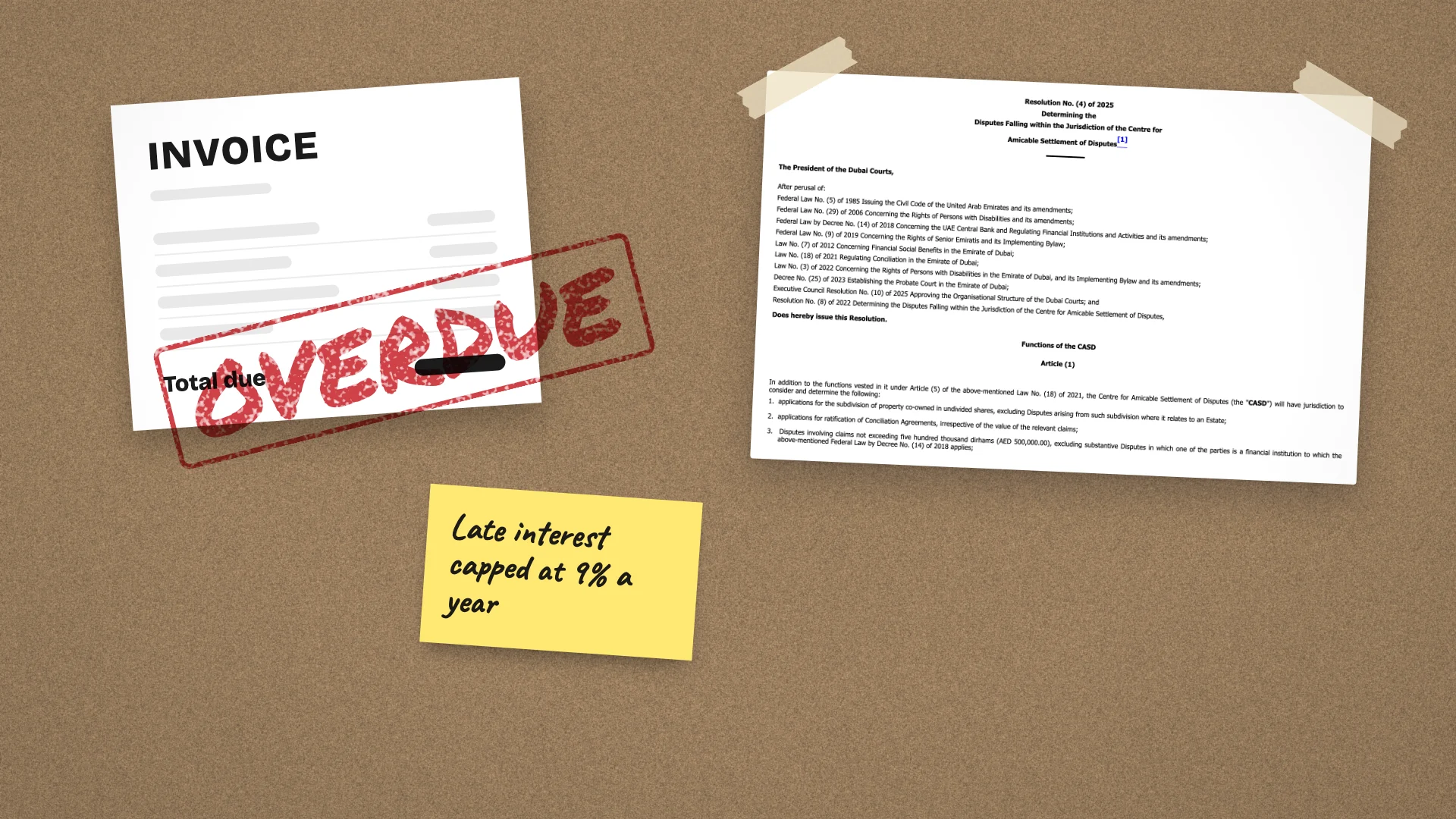
- Interest runs from the due date on a fixed money debt, and you do not need to prove harm (Articles 84 to 86). The rate is the one in your contract or, if none, the market rate at the time, capped at 9% a year until payment (Article 72). Compound interest is not allowed, and the old cap was 12%.
- Courts cannot give the debtor extra time or instalments without your consent, except in general exceptional circumstances (Article 82).
Payment orders
For a debt that is in writing, due and of a fixed amount, such as a signed contract and an unpaid invoice, a payment order under the Civil Procedure Law is the fastest court route. Law-firm summaries of Articles 143 to 150 of Federal Decree-Law 42 of 2022 say you must give the debtor at least five days' written notice first, and the judge decides within three working days. In Dubai the fee is 6% of the claim, with a minimum of AED 500 and a maximum of AED 40,000, and it is not refunded if the order is refused. We could not open the official text, so confirm the details with a lawyer. Pages that cite Cabinet Resolution 57 of 2018 for payment orders are out of date.
Dubai: settlement first, then small claims
- Claims up to AED 500,000 within its remit must go first to the Centre for Amicable Settlement of Disputes, under Dubai Law 18 of 2021 and a 2025 resolution. Settlement must be reached within 30 days of appointing a conciliator, extendable once, and a settlement agreement can be enforced like a judgment.
- Dubai Courts' small claims divisions handle civil and commercial claims up to AED 1 million, under a resolution in force since November 2024.
If you were paid by cheque
- A cheque returned for no or insufficient balance is an executive instrument, enforceable in whole or in part, so you can go straight to enforcement.
- The bank must pay out whatever balance is available unless you refuse it, and you can pursue the rest.
- Present a cheque within six months. Claims against the drawer are barred two years after that period ends.
- A bounced cheque is no longer a crime in itself, but closing the account, withdrawing the balance or stopping payment in bad faith still are.
Time limits
Claims between traders over commercial business are barred five years after the due date, down from ten under the old law (Article 92). Do not let a disputed invoice sit for years.
Protecting future invoices
- Put payment terms, late payment interest and the notice method in every contract.
- Get a signed scope or purchase order, so the debt is clearly written, due and fixed.
- Take deposits for project work, and pause work when unpaid invoices pass an agreed limit.
- Keep a dated record of every reminder.
Our guide to getting paid on time covers prevention: payment terms, reminders and deposits. The invoice generator on this site produces a clear invoice with terms and due date.