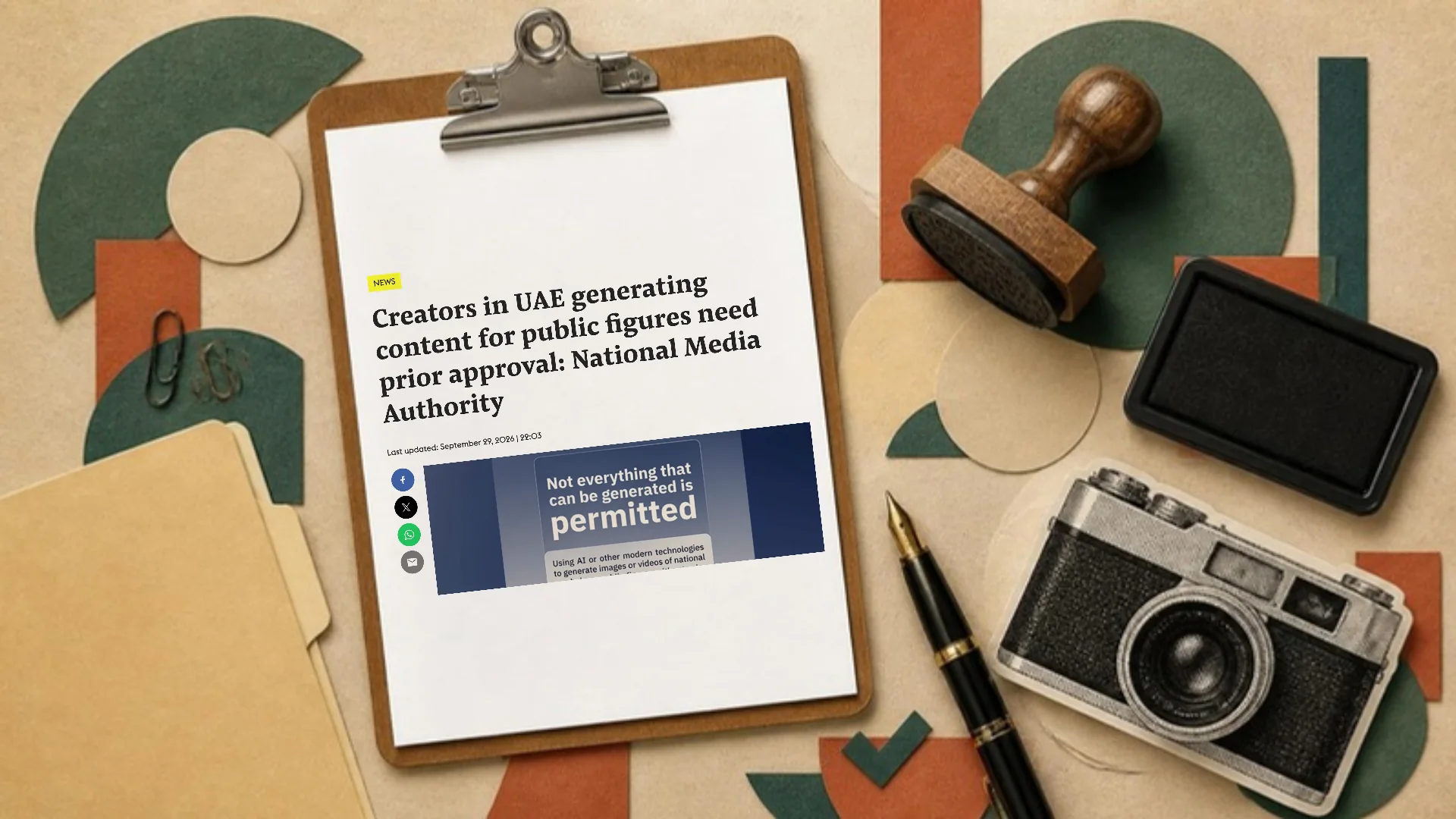
On 29 September 2026 the UAE's National Media Authority said that using artificial intelligence to generate images or videos of national symbols or public figures requires prior official approval. The point was raised by Saeed Al Eter, head of the UAE Government Media Office, at a Government Communication Network meeting where a guide to AI for government communicators was launched, as reported by Gulf Today. No penalties were stated.
What it covers
Two kinds of subject were named: national symbols, which would include the flag, the emblem and similar state imagery, and public figures. In the UAE that plainly includes the country's leaders, and creators and brands should read it broadly. The rule is about generating them with AI, not about filming or photographing real events.
For agencies this lands on a common habit. National Day content, Flag Day posts and patriotic campaign moments often lean on symbols, and AI tools make it easy to produce an image of a leader or a stylised national scene in seconds. Under this statement, that needs approval first.
Who regulates creators now
Much coverage still names the UAE Media Council, but the regulator has changed. A Federal Decree-Law dated 18 December 2025 established the National Media Authority, which took over the functions of the UAE Media Council, the National Media Office and the WAM news agency. Contracts, briefs and internal guides that refer to the Media Council should be updated.
The Advertiser Permit, briefly
- Compulsory since 1 February 2026, after the deadline was extended to 31 January.
- Covers paid and unpaid promotion by citizens, residents and visitors.
- Free for residents for the first three years, and valid for one year for residents. Visitors get a three-month permit, applied for through licensed UAE agencies.
- Exempt: promoting your own business on your own account, and under-18s making educational, cultural, sports or awareness content.
Reported fines vary between sources. Gulf News cites 5,000 to 1,000,000 dirhams, while Communicate reported up to 10,000 dirhams for missing the permit deadline. Larger figures circulating on consultancy blogs have no official source we could find.
What agencies should do now
- Add a line to every brief and creator contract: no AI-generated images or video of national symbols or public figures without written approval obtained by the agency first.
- Check the National Day plan now. Any concept built on AI imagery of the flag, the emblem or leaders needs either approval or a different idea, and approval takes time.
- Keep real photography and footage for patriotic content, with proper rights, where possible.
- Confirm every UAE creator on a campaign holds a valid Advertiser Permit, and record the number and expiry date with the contract.
- For visiting creators, apply for the three-month permit through a licensed agency well before the shoot.
- Label paid content clearly. The permit and disclosure rules work together, and a missing label is the easiest breach to spot.
Saudi Arabia has its own regime. Creators there need a Mawthooq licence, in force since October 2022, and foreign creators must work through licensed Saudi entities. We found no change to Mawthooq dated September or October 2026.
The influencer disclosure checker on this site reviews a caption for clear paid partnership labelling before it goes live.