Agencies rarely lose clients because they said no once. They lose them because they said yes too often, delivered late or badly as a result, and then had the difficult conversation about it three months too late. A clear no, said early and with an alternative, protects the relationship. Here is how to say it.
Why yes costs more than it looks
Scope creep is not an agency quirk. The Project Management Institute found that 52% of projects across industries experienced it in 2018, up from 43% five years earlier. Agencies feel it most because the work is ongoing and the requests are small. Ignition's 2025 report on US agencies found nearly 80% rarely or only sometimes charge for out-of-scope work. Every unpriced extra is paid for by the work you were already paid to do.
The four kinds of no
- Not like this. The request would hurt the result. Explain why, and offer the version that works.
- Not now. It is a good idea, but it would push something agreed. Offer a date.
- Not for this fee. It is outside the scope. Offer it as a change request with a price.
- Not us. It is outside what you do well. Refer it, and say so. Clients trust an agency that knows its limits.
What to say
The words matter less than the order: acknowledge the goal, state the constraint, offer the alternative. Some lines that work:
- "I see why you want this before the launch. If we add it now, the launch posts move by a week. Would you rather we do it straight after?"
- "That's outside this month's retainer. I'll send you a quote today so you can decide; if you approve it, we'll start on Monday."
- "We could do that, but it isn't where we're strongest. I'd rather introduce you to someone who does it every day."
- "Let's not change the caption after approval. If it's important, I'll send it back to you to approve again so we both have the record."
Turn not for this fee into a change request
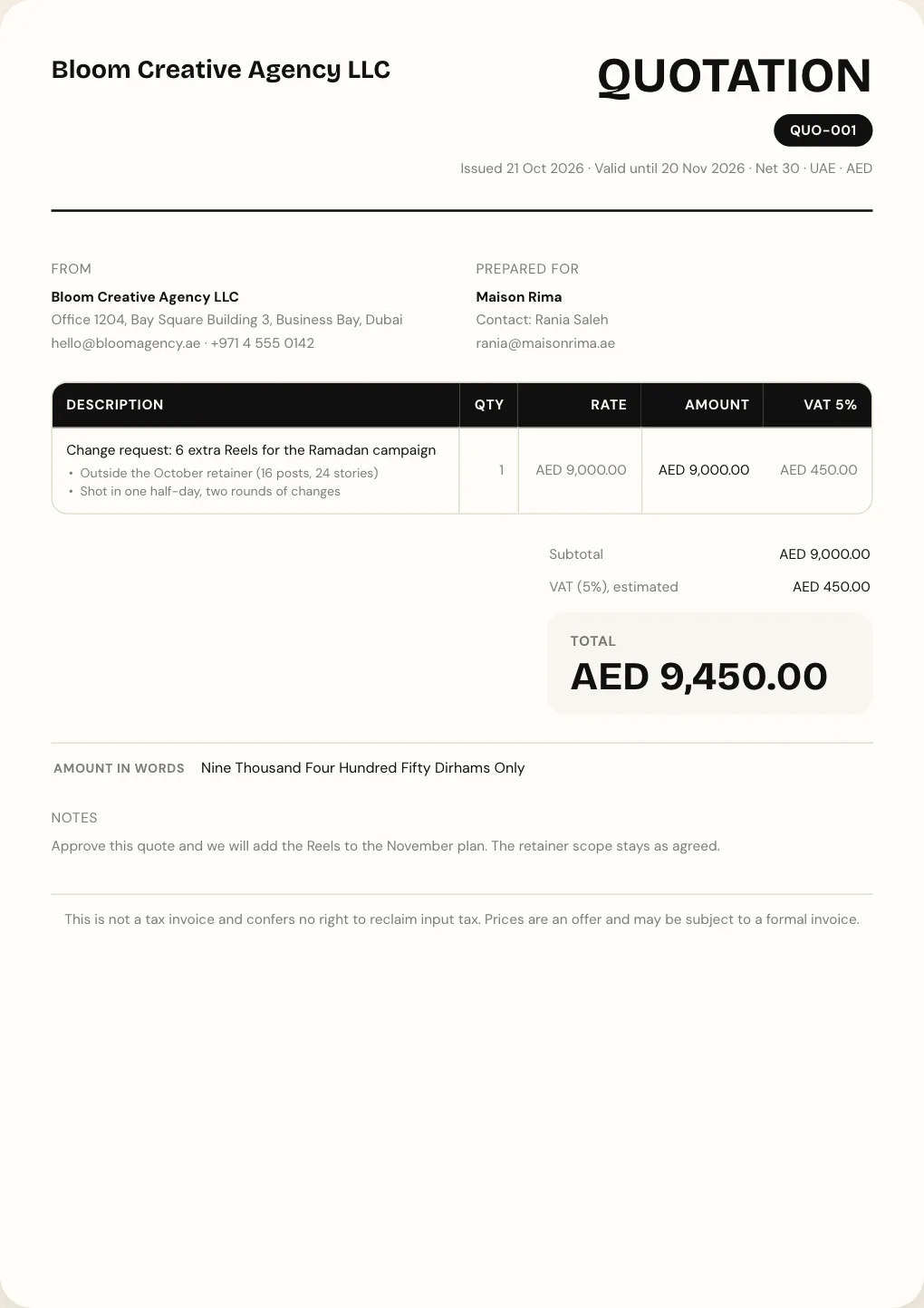
The most useful no is a priced yes. Write the extra work as its own quote, name what it adds to, and leave the retainer untouched. The client gets a clear choice, and you never have to explain later why the scope quietly grew. Here is a sample change request, made with Wiro's free quotation generator, for six extra Reels outside a monthly retainer.
Build the no into the process
- Write the scope down. A retainer that says 16 posts and 24 stories a month makes the 17th post a conversation about a quote, not about trust.
- Agree how changes work at the start: who asks, who approves, and how they are priced.
- Get approvals in writing. When a client approves content in a review link rather than a chat, the record settles disagreements before they start.
- Say no early. A request declined on the day it arrives is a small conversation. One declined after a week of silence is a big one.
- Let a senior person say the hard nos. It shows the agency, not the account manager, holds the line.
Watch the delivery, not just the asks
Agencies keep clients for an average of two to five years, according to AgencyAnalytics' 2024 benchmarks, and 47% of agencies say reporting is critical to keeping them. The pattern behind both is the same: clients stay when they can see the work is delivered as agreed. A disciplined no is part of that, because it keeps what you promised deliverable.
A clear no, said early with an alternative, protects the account. A quiet yes slowly costs it.
The clients worth keeping respect an agency that tells them the truth about time, money and results. The ones who do not tend to cost more than they pay.