There is no single Saudi advertising code. The rules come from the media regulator, the Ministry of Commerce and sector regulators such as the real estate authority, each with its own penalties. A new Media Law that would merge the main media laws was put out for consultation in 2020 and again in 2023, but we found no evidence it has been enacted, so its draft fines of up to SAR 10 million are not law.
Who does what
- The General Authority for Media Regulation, GAMR, formerly the General Commission for Audiovisual Media, enforces the Audiovisual Media Law, the Press and Publications Law, the Mawthooq influencer licence and media content controls.
- The Ministry of Commerce enforces the E-Commerce Law and joins GAMR on circulars about unlicensed advertisers.
- Sector regulators police their own ads. The Real Estate General Authority can fine misleading property ads up to SAR 200,000, doubled on repeat.
- The Saudi Data and AI Authority, SDAIA, enforces the Personal Data Protection Law, which governs marketing messages.
What ads cannot do
A lawyer's summary of Article 5 of the Audiovisual Media Law, reported by Okaz, lists insults to Islam, incitement and hatred, false information, invasion of privacy, harm to the Kingdom's foreign relations, and ads for unlicensed medicines, supplements or investment products.
The 2025 content controls
In September 2025 GAMR issued content controls, reported by Al Jazeera and others, that ban:
- exposing family privacy or disputes;
- filming children or domestic workers in daily content, whether shown positively or negatively;
- misleading information;
- vulgar language and flaunting possessions or tribal affiliation;
- mocking nicknames and tribal, sectarian or racist content;
- revealing, tight or transparent clothing.
For brand work with creators, the rule on children and domestic workers is the one most often missed in lifestyle content.
Online ads under the E-Commerce Law
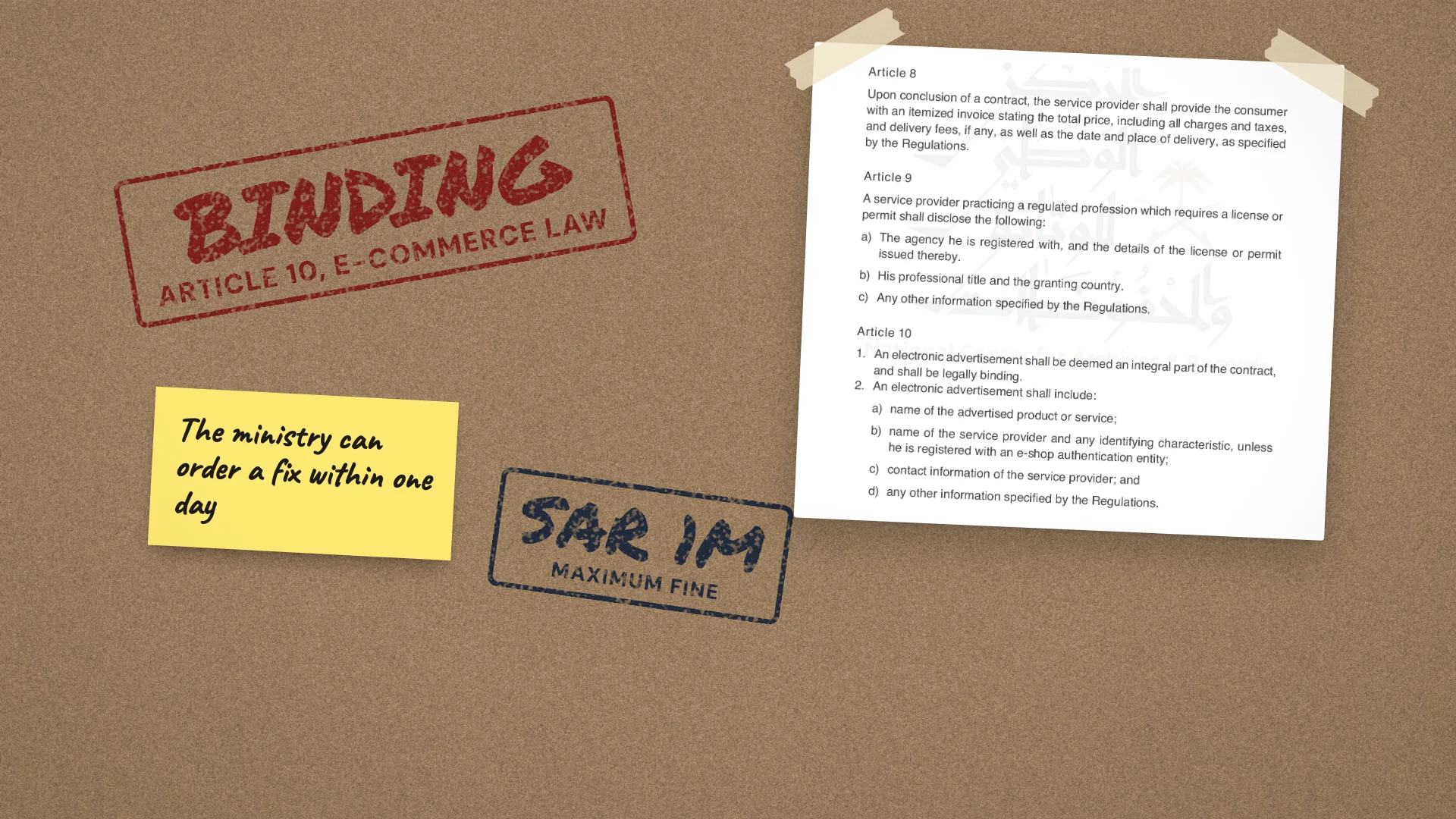
- An electronic advertisement is part of the contract and legally binding. It must name the product, the provider and contact details (Article 10).
- It must not contain false or misleading claims, or counterfeit or unauthorised marks (Article 11).
- The Ministry of Commerce can order an ad corrected or withdrawn within one day (Article 12).
- Penalties include a warning, a fine of up to SAR 1 million, suspension, or blocking the online store (Article 18).
- Consumer data cannot be used or disclosed without consent (Article 5), and the 2020 implementing regulations require ads to say clearly that they are advertising and to give consumers a way to stop receiving them.
Who you can work with
A June 2022 circular from the media regulator and the Ministry of Commerce told businesses not to hire or invite unlicensed non-Saudi advertisers, residents or visitors, and to contract only with people working under an entity with advertising licences. GAMR also licenses advertising offices, marketing offices and advertising agencies. Under its December 2024 statement, foreign investors need a commercial registration in which they own not less than 50%.
A checklist for Saudi campaigns
- Check every claim against the E-Commerce Law: binding, accurate, with the provider identified.
- Brief creators on the 2025 content controls, especially children and domestic workers.
- Confirm every creator's Mawthooq licence, and the licensed entity behind any foreign creator.
- Remember sector rules: property, finance and health have their own regulators.
- Keep the flag, national symbols and leaders' images out of commercial work.
- Be ready to fix an ad within a day if the Ministry asks.
Our guide to Saudi Arabia's influencer licence covers Mawthooq in more detail.