From 2027 every UAE e-invoice will travel over Peppol. You will not need to understand the plumbing to send one, but knowing how it works makes choosing a provider, and talking to clients abroad, much easier.
What Peppol is
Peppol is a set of rules and specifications that lets different e-invoicing systems exchange documents with each other. Its own website says it is not a portal or a provider of exchange services. It is run by OpenPeppol, a not-for-profit international association based in Brussels, set up in 2012 after an EU-funded pilot. In each country a Peppol Authority, usually a government body, oversees the providers. In the UAE that is the Ministry of Finance. OpenPeppol lists 26 authorities, including those of Australia, Belgium, Japan, Malaysia, New Zealand, Oman and Singapore.
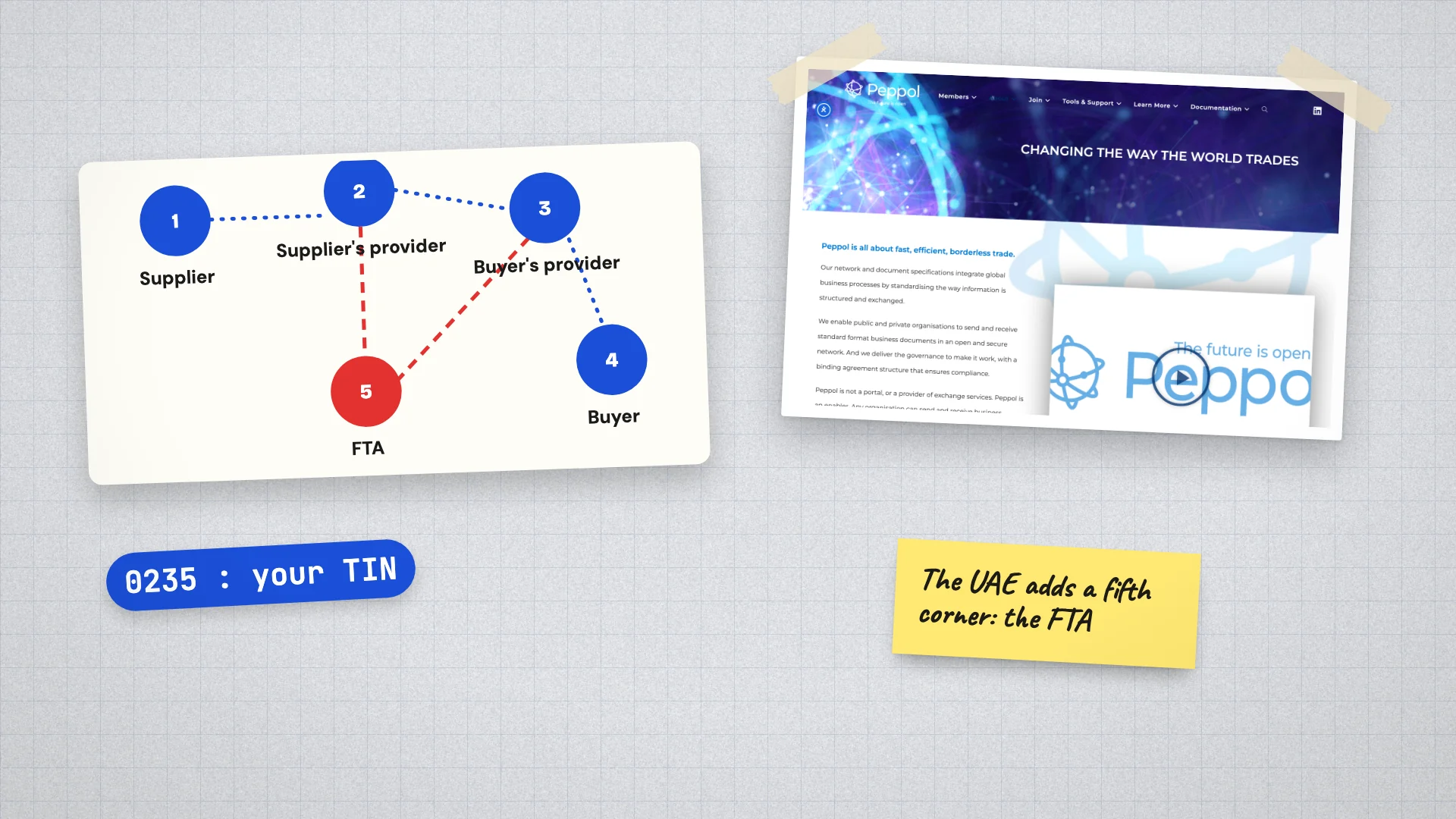
The four corners
- Corner 1 is you, the supplier.
- Corner 2 is your provider, called an access point.
- Corner 3 is your client's provider.
- Corner 4 is your client.
Each side chooses its own provider, much like choosing a mobile network. Your provider looks your client up in Peppol's directory, finds which provider they use and which documents they accept, checks the invoice and delivers it.
The UAE's fifth corner
The UAE adds a fifth corner, the Federal Tax Authority. Your provider reports the invoice's tax data to the FTA as it delivers it, and your client's provider reports too once it has validated the invoice. If validation fails, your client's provider sends a rejection to yours and to the FTA. The Ministry calls this model Decentralized Continuous Transaction Control and Exchange.
Your Peppol ID
Every participant has an ID made of a scheme code and a value. The UAE's scheme is 0235, and the value is your 10-digit Tax Identification Number, the first 10 digits of your TRN. The first digit is always 1, the next eight identify the business, and the tenth is a check digit. Members of a tax group use their own number, not the group representative's. You receive the ID when you onboard with your provider in EmaraTax.
PINT and PINT AE
Countries add their own tax rules on top of a shared international invoice model called PINT, available on Peppol since July 2023. OpenPeppol describes it as roughly 80% shared content, 15% aligned tax content and 5% local detail. The UAE's version is PINT AE. There are others for Japan, Singapore, Malaysia, and Australia with New Zealand.
Where Peppol is used in 2026
- Belgium: since 1 January 2026, structured e-invoices between Belgian VAT-liable businesses are compulsory, sent over Peppol.
- Singapore: InvoiceNow runs on Peppol. IRAS is phasing in a requirement for GST-registered businesses to send invoice data through it, from new voluntary registrants now to all GST-registered businesses by April 2031.
- Australia: e-invoicing is not mandatory for businesses, though there are requirements for government agencies. The tax office became the Peppol Authority in 2019.
- New Zealand: from 1 January 2027, larger government agencies must require large suppliers to send e-invoices.
- Japan: Peppol-based standards exist, but using them is not mandatory.
- Malaysia: the mandate runs through the tax authority's own MyInvois system, not Peppol. Peppol providers are one of the ways to connect to it.
Why it matters for your agency
- A client in Belgium may already receive invoices over Peppol. If a foreign client has a Peppol ID, your UAE e-invoice can reach their system directly.
- If a foreign client has no Peppol ID, your provider uses the export placeholder 0235:9900000099, and the client gets their copy outside the network.
- Whether a foreign client's provider accepts the UAE format depends on what that provider has registered, so test with one client before you promise it to all of them.
For most agencies the practical step is the same: choose an accredited provider by your deadline and make sure your client records are complete. The invoice generator on this site covers today's tax invoice in the meantime.