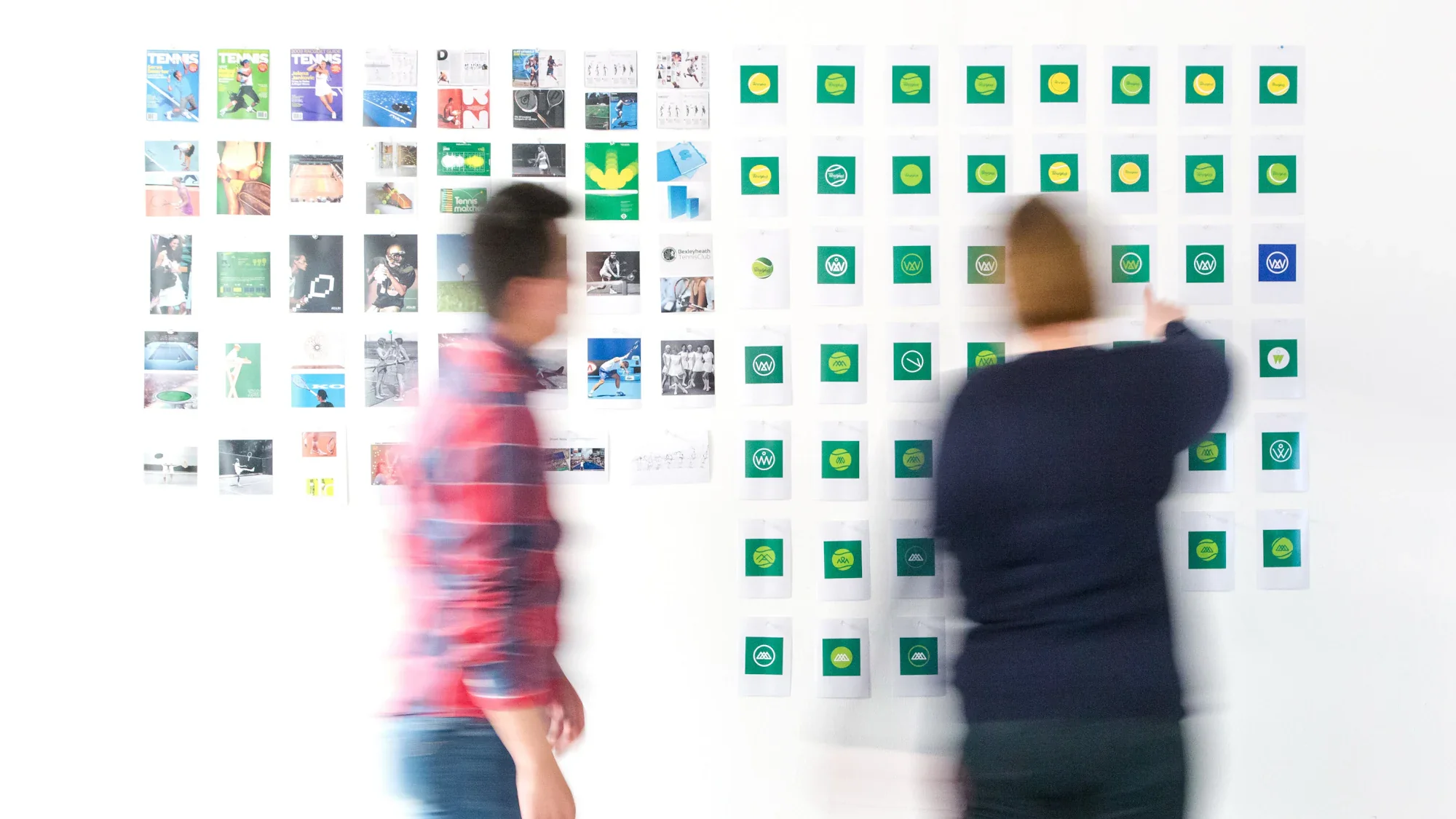
Moodboards fail in a predictable way. The team gathers forty beautiful images, arranges them well, and sends them over. The client replies that they like some of it, points at three pictures that have nothing in common, and asks to see a few more options. A week later there is a second board, and nobody is sure what the first one decided.
The problem is rarely the taste of the images. It is that the board did not say what it was proposing, so the client could only react to pictures one at a time.
Start from the brief, not from the search bar
Before anyone collects a single reference, write down the two or three things the board has to settle. For a campaign that might be the feeling, the colour world and the style of photography. For a rebrand it might be tone, typography and how premium the brand should look. Take them from the brief, in the brief's words where possible.
Those questions become the structure of the board. Every image on it should be there to answer one of them. Anything that does not is decoration, however good it looks, and decoration is what the client will end up commenting on.
Structure it in sections
A board laid out as one grid asks the client to find the pattern. A board laid out in sections shows them the pattern, and lets them agree with one part while questioning another.
- A short opening frame that restates the objective and the audience from the brief.
- One frame per question: mood, colour, photography, typography, texture or motion, whichever the project needs.
- A few references per frame, not dozens. Five chosen images make a point. Twenty dilute it.
- A closing frame that sums up the direction in a sentence and lists what the team will make next.
If there are two genuinely different routes, show them as two clearly labelled directions, each with its own frames, rather than mixing them. Clients find it easy to choose between two coherent routes and hard to untangle one board that contains both.
Choose references with intent
Every reference should earn its place, and the team should be able to say in a few words why it is there: the light in this one, the crop in that one, the way this campaign uses a single colour. A reference kept only because it is beautiful tends to attract the most attention and the least useful feedback.
Be careful with images that carry their own brand. A reference from a well-known competitor, or from a campaign the client dislikes, can end the conversation before it starts. Crop in on the quality you mean, or choose a less loaded example. In the Gulf, check that people, clothing and settings suit the audience and the market the work is for, because a reference that would be fine elsewhere can distract from the point you are making.
References are also not a promise. Say clearly that the board shows a direction and that the final work will be original, so nobody expects a copy of a picture they liked.
Write the rationale on the board
A short note beside each section, one or two sentences, does more for approval than any image. It tells the client what to look at and why it answers the brief: warm, low evening light, because the brief asks for the product to feel like part of family time rather than a treat.
Notes also protect the board when it travels. The client will forward it to a colleague who was not in the meeting, and without the rationale that colleague sees only pictures, and responds to them on taste.
A moodboard without notes asks the client whether they like the pictures. A moodboard with notes asks whether they agree with the thinking, which is a far better question to get a yes to.
Present it, do not just send it
Walk the client through the board, live or on a recorded video if a meeting is not possible, before they see it on their own. Start with the brief, move frame by frame, and end on the summary. Presenting in order stops the client jumping to the one image that surprised them and building the whole conversation around it.
Ask for decisions rather than impressions. Instead of asking what they think, ask whether this is the right feeling, whether this colour world fits, which of the two routes to take forward. Closed questions produce answers the team can act on.
Gather feedback where it belongs
Feedback on a moodboard is only useful if it is attached to the part of the board it refers to. A comment that says less dark, sent in a separate email, could mean the photography, the palette or the whole mood. The same comment pinned to the colour frame is clear.
Collect the comments, sort out anything contradictory with the client's lead approver, and confirm the agreed direction back in writing before any production begins. Save a copy of the board as it was approved, so the finished work can be checked against it later.
Wiro's Mind canvas was built for this kind of board: a Moodboard template laid out in frames, comments pinned to a card or anywhere on the board, named versions such as the one sent to the client, and a Present mode that turns each frame into a slide. Whichever canvas you use, the approach is what earns the first-time yes.