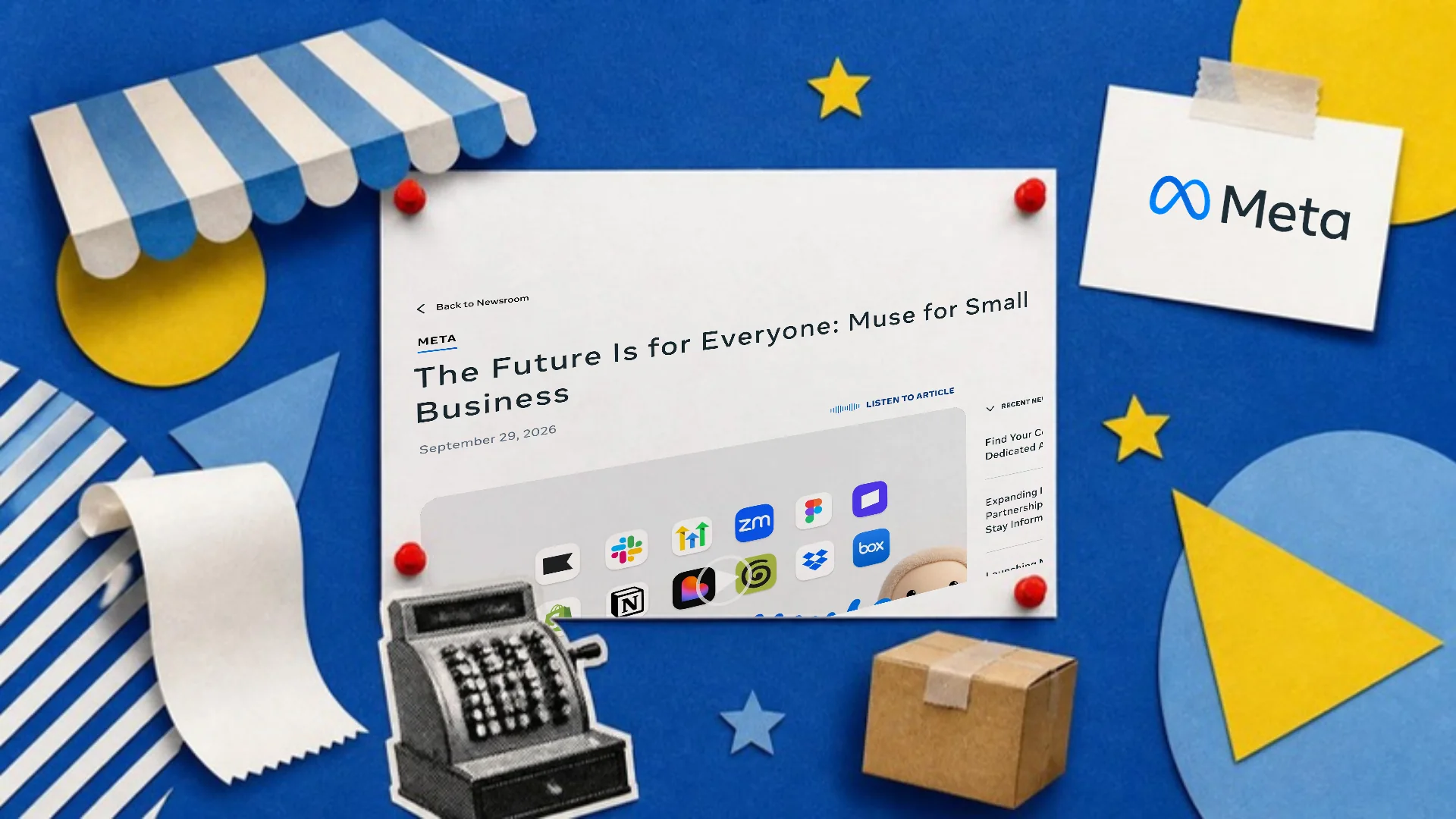
Meta launched Muse, its personal AI agent, on 8 September 2026 in the US, for users aged 18 and over. It is now in the US and Canada on iOS, Android and the web. On 29 September Meta announced Muse for Small Business in its newsroom: not a separate app, but a set of business skills and connectors added to the same agent.
The idea is that an owner gives Muse a goal, such as running the business or finding new customers, and it does the work across the tools the business already uses.
What it connects to
Meta named fifteen connectors at launch: Asana, Box, Canva, Dropbox, Figma, Granola, HighLevel, Intuit QuickBooks, Klaviyo, Lovable, Notion, Shopify, Slack, Stripe and Zoom. It also connects to the owner's Facebook and Instagram business accounts, and custom connectors are supported. The Next Web and The Star report that it can use Instagram professional analytics, Facebook Pages and Meta ad accounts.
What Meta says it can do
- Analyse sales, campaigns and social activity, then draft a growth plan.
- Review finances and flag unusual expenses.
- Work out which ads and content perform, then draft a new campaign.
- Sort an overloaded inbox and calendar and draft replies.
- Suggest priority tasks before being asked.
Meta's line on control is that nothing publishes, sends or spends without the owner's approval. Meta's own post does not mention Meta Business Suite, Ads Manager by name or WhatsApp Business, and we found no WhatsApp Business link.
How many people use Muse
Meta has not published usage figures for Muse itself. Sensor Tower projected that the app passed 5 million US downloads on 30 September, 22 days after launch, faster than it measured for ChatGPT. The Information reported more than 3 million weekly active users. Meta also promoted the app heavily: The Next Web reported a download spike when Meta's ad campaign began on 16 September. Meta's vice president Vishal Shah said about a third of early testers connected Muse to business accounts.
Price and availability
Meta says Muse is free with usage limits, with paid subscriptions for more use, and there is no separate business price. Monthly tiers of 20 and 100 dollars have been reported by other outlets but we could not confirm them on a Meta page. It is available in the US and Canada only, and Meta has not named other countries. Businesses in the UAE and Saudi Arabia cannot use it yet.
Why agencies should pay attention
Muse is aimed squarely at the small business owner who might otherwise hire a freelancer or a small agency to plan content, check campaign results and draft ads. When it reaches the Gulf, some clients will try it before calling you, and some will arrive with a plan Muse wrote.
- Be the one who explains it. A short note to small clients on what Muse can and cannot do builds more trust than waiting for them to ask.
- Compete on what an agent does not have: local market knowledge, Arabic copy that sounds native, relationships with creators and media, and accountability for results.
- Check access before anything else. An agent that can read ad accounts and analytics needs the same care as a new team member: decide who connects it, to which accounts, and who approves its drafts.
- Expect agent-written briefs. Ask what data the plan was built on before accepting its numbers.
Muse also sits alongside Meta One, Meta's subscription launched on 15 September 2026, whose plans include more AI image and video generation through Muse models. The AI layer across Meta's apps is becoming something businesses pay for, not only a free feature.
The ad metrics calculator on this site works out cost per result, CPM, CTR and ROAS from a campaign's numbers, useful for checking any performance summary, whoever or whatever wrote it.