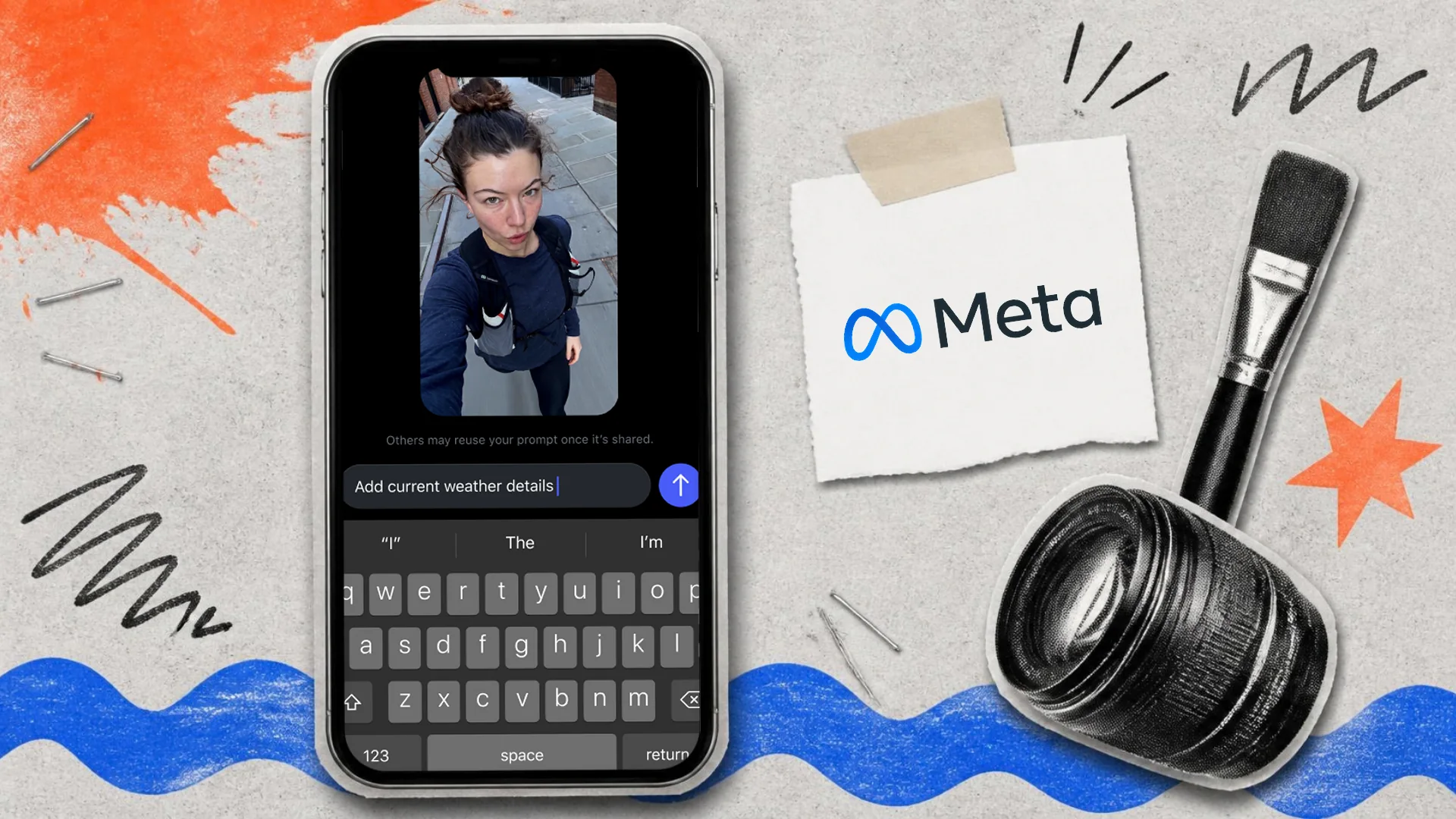
Muse Image is the first image model from Meta Superintelligence Labs, launched on 7 July 2026 in the Meta AI app and on meta.ai. It was developed under the codename Mango, according to TechCrunch, and follows Emu, the model behind Meta's earlier Imagine feature. It already powers new effects in Instagram Stories in the US, and Meta says it is coming to Advantage+ creative, the AI tools in Ads Manager.
What it does
- Makes images from a conversation, with more than 30 suggested prompts to start from.
- Plans the picture first. Alexandr Wang, who leads Meta's AI lab, described it as agentic: it works with Muse Spark to reason, search the web and plan the layout before generating, and can call tools to draw things such as charts and QR codes.
- Combines several reference photos into one picture.
- Edits by sketching or annotating directly on an image.
- Renders legible text, for example in infographics.
- Restores old photos and removes objects.
- Redesigns rooms using real products from retailers or Facebook Marketplace.
Where it is available
- The Meta AI app and meta.ai, since 7 July.
- Instagram Stories, where more than 30 effects built on Muse Image, such as Night Flash and Disposable, are available in the US only.
- WhatsApp chats with Meta AI, in a limited set of countries Meta has not named.
- Facebook and Messenger, which Meta says are coming.
- Developers, through Meta's model API since 25 August, at one US cent per image and up to 1,600 pixels, and through partners including fal, Runway and OpenRouter.
Meta has not confirmed Muse Image in the UAE or Saudi Arabia, or that it handles Arabic. Check in the Meta AI app on a local account before promising a client anything, and test Arabic text in images before relying on it.
How good is it?
At launch Meta cited LMArena, where people vote between images without knowing which model made them: in early July Muse Image placed second in text-to-image and in image editing, behind OpenAI's GPT Image 2. The field has moved fast since. By 21 September it had slipped to seventh in text-to-image and sixth in image editing on the same leaderboard, and Artificial Analysis also ranked it seventh. Muse Video, previewed alongside it, stood ninth in text-to-video. Articles still quoting the July rankings are out of date.
For agencies, rank matters less than fit. The strengths Meta describes, planning a layout and rendering text, suit social graphics and ad variations. For a campaign's hero image, a photographer or designer is still the safer choice.
The Instagram photo controversy
Muse Image launched with a feature that let anyone mention a public Instagram account and use that person's photos in a generated image. Public accounts were included by default, owners were not notified, and the opt-out sat in a sharing menu. NBC News reported that it could make deepfakes of ordinary people and celebrities, and CAA and SAG-AFTRA objected. Meta removed the feature on 10 July, three days after launch, and acknowledged it had got it wrong. The image model stayed.
Separately, a proposed class action filed in Chicago on 4 September 2026, as reported by a US law firm, alleges that Meta used Facebook and Instagram photos, including biometric data, to train its image models, Muse Image among them. Meta disputes it.
Watermarks and labels
- Muse Image output carries an invisible watermark Meta calls Content Seal, which Meta says survives cropping, compression and screenshots. There is no visible mark.
- Engadget reported that Content Seal is proprietary and does not work with the C2PA industry standard or Google's SynthID.
- A Reuters test of 40 images found Meta's own detection tool missed 55 percent of them once they were heavily cropped. Meta said the tool is a preview.
- Meta labels AI content on Facebook and Instagram as AI info, based on industry signals or self-disclosure. We could not confirm that Muse Image posts are labelled automatically.
Rules for using it on client work
- Disclose AI-generated images yourself, using the AI label when posting, rather than relying on detection.
- Never generate real people, including staff and customers, without their written consent.
- Keep logos and product shots real where accuracy matters. AI can change a product's shape, colour or text.
- Check the terms before publishing. Meta's terms for the Meta AI app do not clearly say whether its images may be used commercially, and images made with Meta's ad tools may only be used on Meta's platforms.
- Keep a record of prompts and outputs for anything published, in case a rights question comes up later.
- For clients running campaigns in Europe, note that transparency rules for AI content under the EU AI Act have applied since 2 August 2026.
The ad mockup generator on this site shows any image, generated or not, in Facebook and Instagram placements, and the social media image resizer crops it for every platform at once.