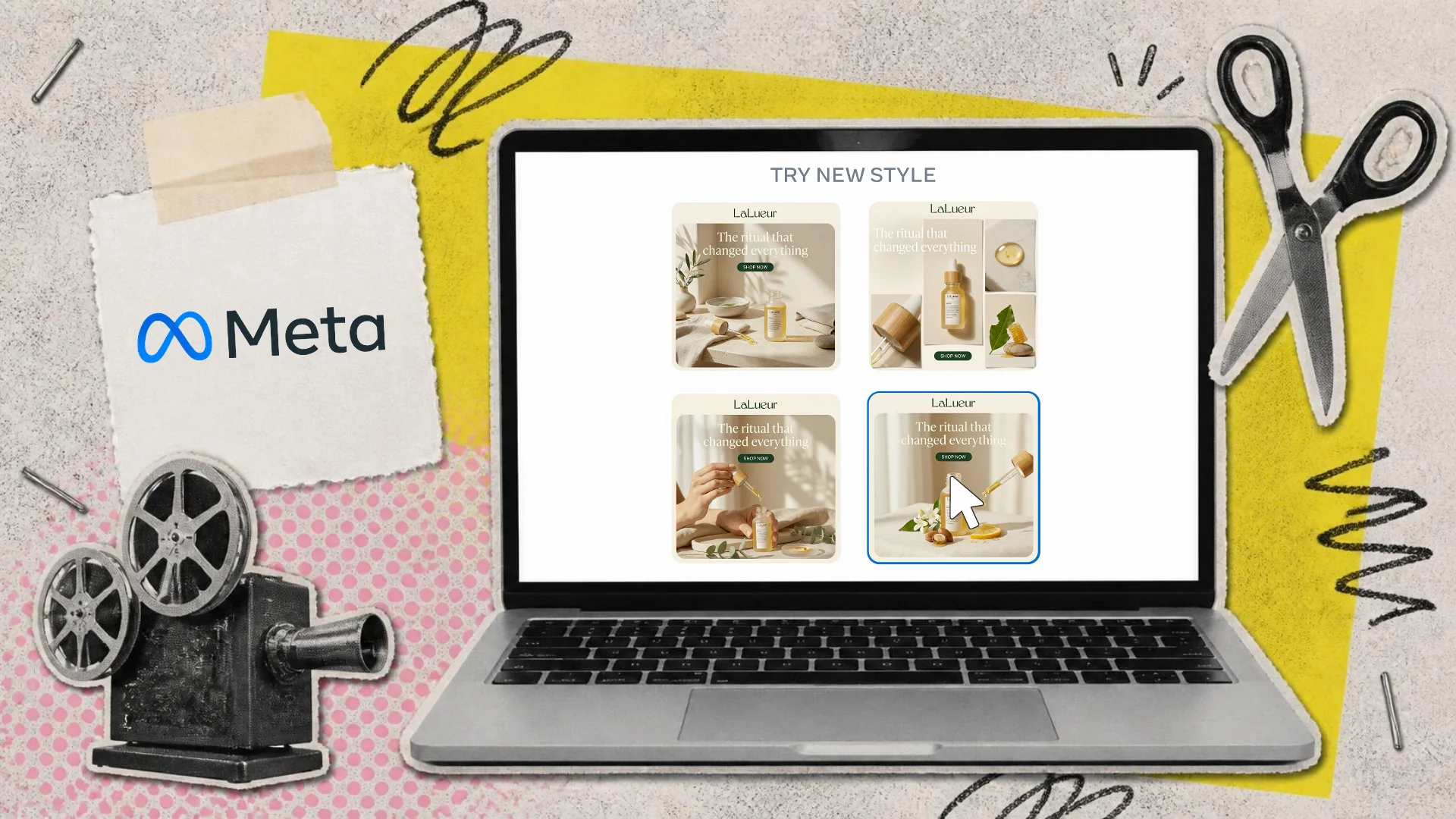
On 7 July 2026, when Meta launched Muse Image, it said advertisers and agencies would be able to use it through Advantage+ creative, the AI tools inside Ads Manager, in the coming weeks. Three weeks later Mark Zuckerberg told investors that Muse Image would supercharge Meta's new end-to-end creative tools, analysing images, improving its own work and producing better ad variations from what advertisers give it. It is the part of the Muse family most likely to touch a Gulf agency's work this year. As of late September, it is also not confirmed as live.
What Meta says Muse will do in ads
- Generate new backgrounds around product images.
- Create full lifestyle variations inspired by a brand's existing ads.
- Make still images directly from a brand's video creative.
- Restyle rooms with products from a business's catalogue in Meta AI's shopping mode, for US businesses.
Meta published only qualitative feedback from testers, among them AG1, Origin USA and the agency Tinuiti, who praised the photorealism, accurate brand details and packaging that stayed intact. It has published no performance figures for Muse-generated ads.
What is actually live
Meta has not announced that Muse Image has reached Advantage+ creative. Its business news pages carried no launch post as of 21 September, and Susan Li, Meta's chief financial officer, spoke about the rollout in the future tense on 29 July. Features in Ads Manager often appear account by account without an announcement, so check the image generation options in clients' accounts, but do not tell a client their ads are being made with Muse unless you can see it.
Several tools that exist today may or may not use Muse behind the scenes. Background generation, image expansion, image generation, text generation, image touch-up and image animation are all in Advantage+ creative, and generating images from video is new this year. Meta has not said which model runs each one. Li said adoption of image generation among advertisers more than doubled in the second quarter of 2026.
Who owns an AI ad image
This is the point most agencies miss. Meta's terms for its ad creative AI tools, in force since May 2024, say images made with them may be used on Meta's platforms, and that using or publishing them outside Meta's platforms is not authorised. An image Advantage+ generates for a client's Instagram ad cannot go on the client's website, a billboard or a TV spot. The terms also say:
- The output may not be unique, so a competitor can get the same or a similar image.
- Watermarks and authentication data must not be removed, and the output must not be presented as made by a person.
- Meta gets a permanent licence to what you upload, and the advertiser alone is responsible for checking the output.
Images made in the Meta AI app fall under different terms, which do not clearly say whether they may be used commercially. Images made through Meta's developer API, at one US cent each, belong to the developer under those terms, though they are not unique either. If a client needs an image they can use everywhere, make it with a tool whose terms allow that, or with a photographer.
How AI ads are labelled
- Meta gives an AI info label to ads its tools changed significantly, such as through background generation or image generation. Resizing and colour correction do not count.
- If Meta's tools add a photorealistic person, the label appears next to the ad label itself; otherwise it sits in the About this ad menu, which Meta is redesigning.
- Meta has started detecting ads made with other companies' AI tools through industry signals.
- Ads about social issues, elections or politics must disclose realistic AI content themselves, and ads that do not are rejected.
Keeping control of the brand
Meta's answer to brand safety is a set of controls: a branding section that stores logos, colours, fonts and tone, previews before publishing, and the option to switch off generated versions. Its brand memory, announced at Cannes in June and still in testing, learns a brand's identity and tone from its past ads, with WPP as the first agency partner and Unilever the first client. A creative approval workflow inside the tool is also being tested. Meta has not said whether either runs on Muse.
Agencies have reason to be careful. In December 2025 Business Insider reported that Meta had swapped an apparel brand's best-performing ad for an AI-generated image of an elderly woman, and that advertisers found generation settings switched back on after turning them off. Agency leaders told Marketing Brew in April 2026 that finding automatically enabled features felt like a game of whack-a-mole. Meta itself says previews do not show every variation that may run.
A policy for Gulf agencies
- Decide with each client, in writing, which AI features may run on their ads, and check every new ad set for features switched on by default.
- Keep AI-generated ad images on Meta, and never reuse them on the website, outdoors or in print.
- Keep product photography real. A generated background is one thing; a generated product is a misrepresentation waiting to happen.
- Do not generate people for regulated categories, and take extra care with political and social issue ads.
- Review any Arabic text in an image. Meta has not said Muse renders Arabic, and Arabic was not among the new languages for translating text on images.
- Keep a record of what was generated, and for which campaign, in case of a complaint.
What about Muse Video?
Meta previewed Muse Video alongside Muse Image, saying it generates video with sound but still struggles with syncing audio and with fast motion. It has not launched, and Meta has said nothing about it in ads. Meta's existing video generation tools are already big business: Meta said they reached an annual revenue run rate of 10 billion dollars at the end of 2025, and that advertisers using them saw conversion rates more than 3 percent higher in tests.
The ad mockup generator on this site shows any generated image in every Meta placement, with each app's text cuts, so it can be checked before it goes to the client, let alone the auction.