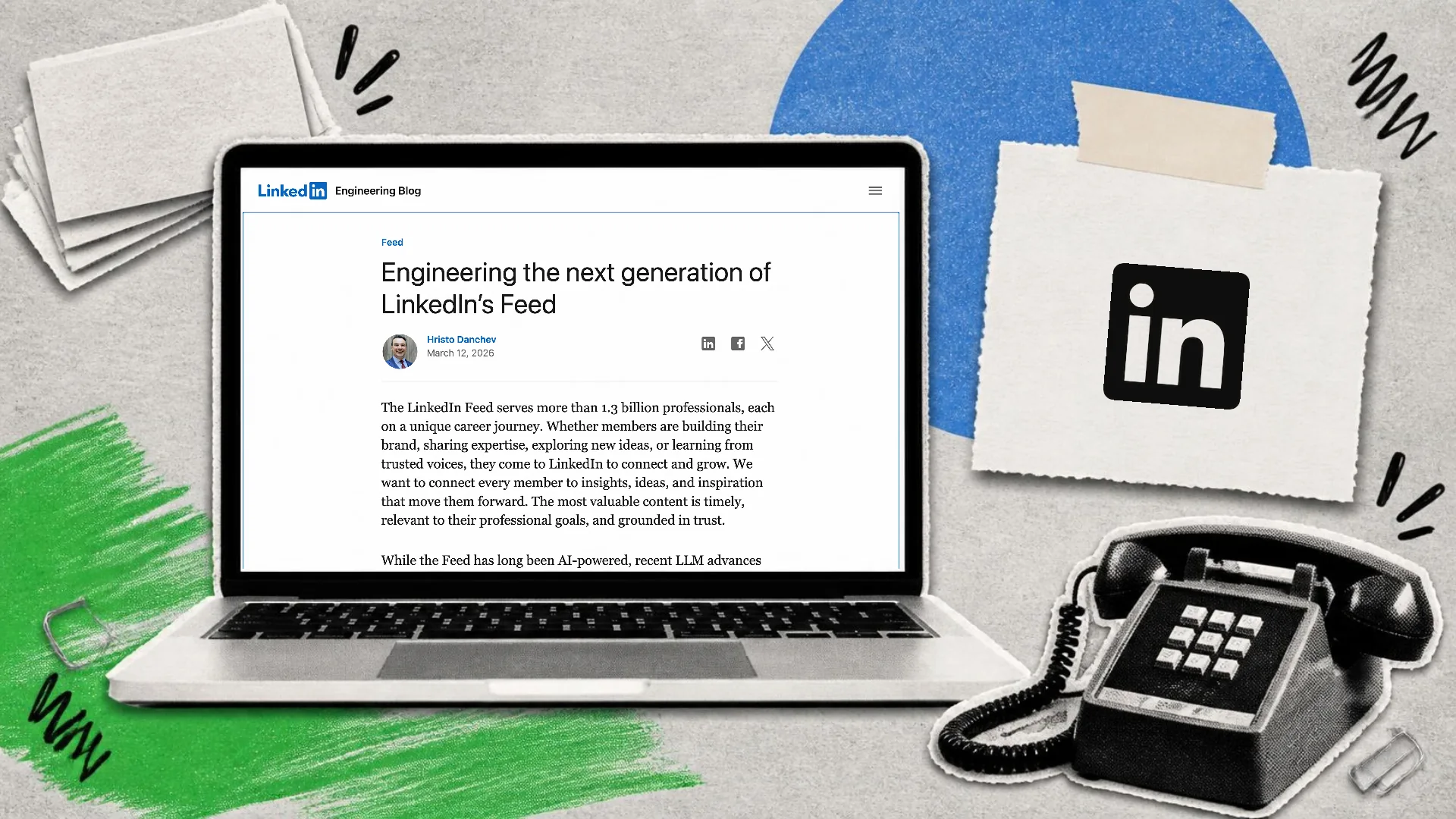
On 12 March 2026 LinkedIn published a detailed account of how it had rebuilt its feed. The several separate systems that used to pick candidate posts for each person were replaced by one, built on a large language model, and a new model now ranks them. The same day Tim Jurka, a LinkedIn engineering vice president, set out what the feed would show less of. Since then LinkedIn has gone after engagement pods, automated comments and generic AI-written posts. For agencies writing for brand pages and founders, it is the biggest change to LinkedIn in years.
How the new feed chooses posts
LinkedIn's engineering post describes two stages:
- Retrieval. LinkedIn used to gather candidate posts from several sources: recent activity in your network, trending posts in your area and industry, and several recommendation systems. It replaced them with one system that uses a language model to describe posts and members in text and match them by meaning rather than keywords. A post is described by its text, format, author, the author's headline, company and industry, and the engagement it has had. A member is described by their profile, skills, work history, education and the posts they have engaged with.
- Ranking. A model LinkedIn calls a Generative Recommender reads more than a thousand of each member's past interactions and predicts what they will do with a post: click, skip, stay on it for a long time, like, comment or share.
LinkedIn's example is a member interested in electrical engineering being shown posts about small modular reactors: related in meaning, though they share no keywords. New posts are processed almost in real time, and posts gaining engagement are updated as they go, so posts about breaking news can reach people within minutes. LinkedIn also says it audits the models to make sure posts from different creators compete on equal terms.
LinkedIn did not publish how much any signal counts, and the engineering post says nothing about links, hashtags, video, documents or how often to post. Format is one input among many.
Your network matters less
Jurka wrote that the feed now shows relevant posts whether they come from someone's network or from people they have never connected with. A post on a narrow subject can reach the people interested in that subject, even if the author has few followers. By the same logic, a large following does not guarantee reach for posts those followers do not care about. Since June 2026, creators' post analytics split reach between people in their network and people outside it, which makes this visible. LinkedIn has not said the same split is coming to Company Pages.
What LinkedIn is showing less of
- Posts that ask readers to comment a word to show agreement.
- Text posts with an unrelated video attached to get more distribution.
- Recycled thought leadership that says little.
- Engagement pods, which LinkedIn defines as coordinated groups that like, comment and share to boost each other. It says it removes such groups, gives artificially boosted posts less reach, and may restrict members who take part or remove them from programmes such as Top Voices.
- Automated comments from third-party software or browser extensions, which are not allowed and are kept out of the most relevant comments.
- Generic AI-written posts and comments. In May 2026 LinkedIn said content showing signs of AI slop is less likely to be shown beyond the author's network, and that its detection was right 94 percent of the time in early testing. In September it said views of content classified as AI slop were down 40 percent, that more than a million members used a new report option in its first two weeks, and that it blocks hundreds of thousands of automated comment attempts a day.
Links, hashtags, scheduling and frequency
- Links: a LinkedIn product director said in 2025 that a link does not intentionally limit a post's reach, as long as the post makes sense without clicking it. The studies claiming links cut reach come from third parties.
- Hashtags: LinkedIn's product leaders have said they do not affect distribution, and the hashtag feed is being phased out. An older LinkedIn best-practice page still recommends three to five, so LinkedIn's own material disagrees.
- Scheduling tools: LinkedIn said in 2025 that posting through a scheduling tool or the API has no effect on reach.
- Frequency: a LinkedIn product vice president suggested two to five posts a week, and said members who post twice a week get up to five times more profile views.
- Dwell time, how long people stay on a post, has been a ranking signal since 2020 and is one of the actions the new model predicts. Nothing LinkedIn has published says it became the main signal.
Myths to drop
- A golden hour. LinkedIn has never said the first hour decides a post's reach, and its engineering post describes posts being re-scored continuously.
- A comment is worth a set number of likes. LinkedIn has published no weights.
- Carousels or document posts get a boost. No boost for any format has been stated.
- A named March 2026 authenticity update, a 97 percent detection rate, or pods losing 45 percent of reach. LinkedIn's own numbers are the 94 and 40 percent above.
- 360Brew, a large model described in a LinkedIn research paper, runs the feed. Jurka said LinkedIn tested it, decided it did not fit, and shut the test down.
What it means for brand and founder posts
- Write for a subject, not for your followers. Be specific, so the model can match the post to the people who care about it.
- Make every post stand on its own. If there is a link, the post should be worth reading without clicking it.
- Put the author's real expertise in their headline and profile. The model reads them.
- Drop engagement bait, pods and comment automation, including from any agency or tool that offers them.
- Use AI to edit, not to write. LinkedIn's own AI writing tools now focus on proofreading.
- Where the analytics show it, report reach outside the network as well as total impressions.
The free caption and hashtag checker on this site checks a post against LinkedIn's character limit, and the best time to post tool shows when Gulf audiences are most active.