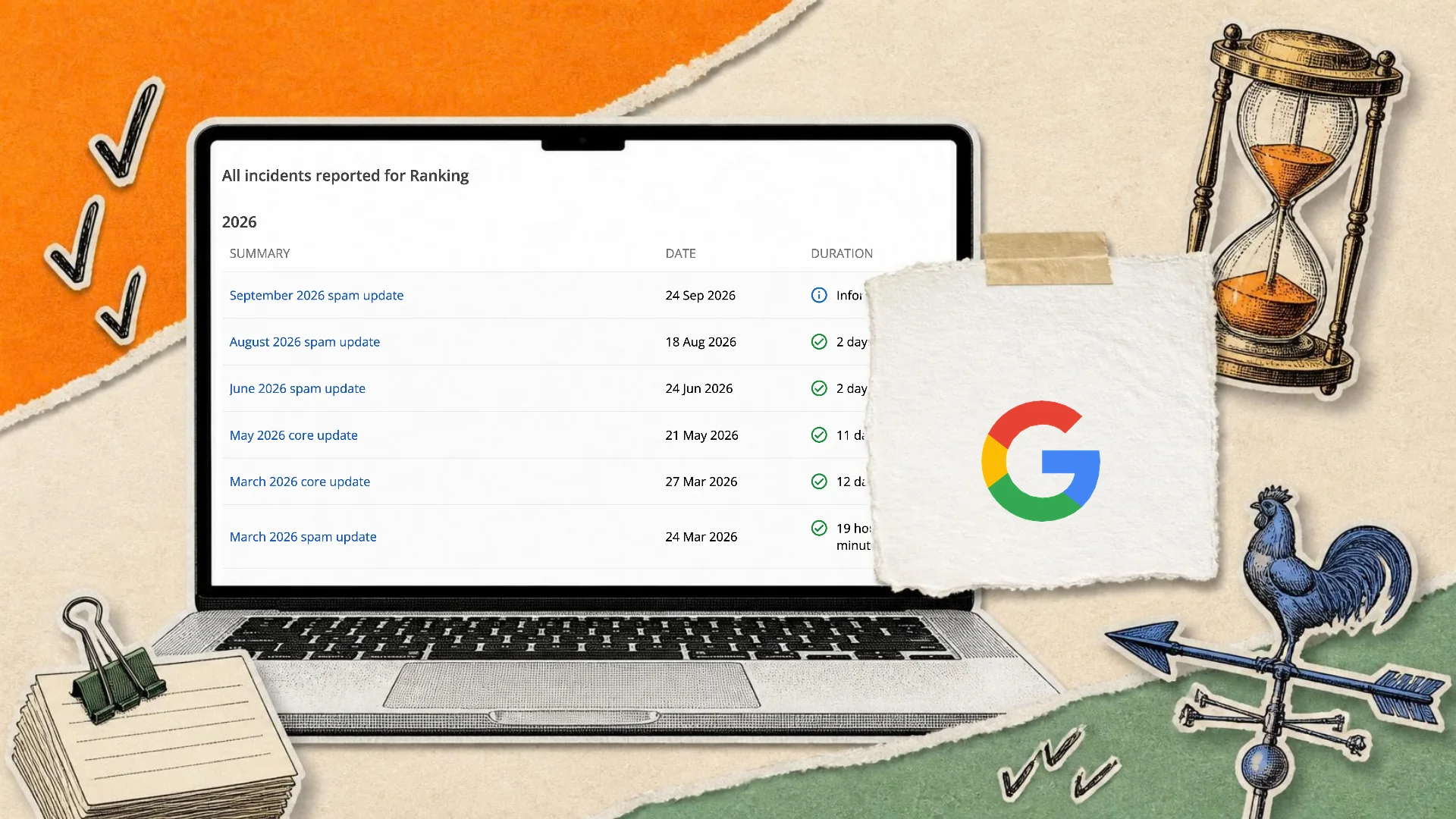
Google's Search Status Dashboard is the only official record of ranking updates, and it lists six in 2026 so far. Google explained only one of them in a blog post. Alongside them it changed its spam policies, retired FAQ rich results and published its first guide to appearing in AI search. Here is the record, with dates.
Confirmed updates
- February 2026 Discover core update, 5 to 27 February: the first core update Google has applied to Discover alone, for US English users first. Google said it aimed to show more locally relevant content from sites in the user's country, less clickbait and sensationalism, and more in-depth, original and timely content from sites with expertise.
- March 2026 spam update, 24 to 25 March, global.
- March 2026 core update, 27 March to 8 April.
- May 2026 core update, 21 May to 2 June.
- June 2026 spam update, 24 to 26 June, global.
- August 2026 spam update, 18 to 21 August, global, with no new policy.
Google also says smaller core updates happen continuously without being announced, and that recovery after a core update can take months.
New and changed rules
- Back button hijacking: a new spam policy from April 2026, enforced since 15 June, against sites that interfere with the browser's back button. The site owner is responsible even when the code comes from an ad network or another third-party script.
- Manipulating AI answers: since May 2026 Google's definition of spam includes attempts to manipulate generative AI responses in Search.
- Site reputation abuse: since 30 August, manual actions under this policy no longer apply in the European Economic Area, after a European Commission investigation. Elsewhere, including the Gulf, enforcement is unchanged.
- Reviews: a guideline added in July 2026 against fake or undisclosed incentivised reviews in review snippets.
- AI-generated content: no change. Using AI mainly to manipulate rankings still breaks the spam policies, and Google still says E-E-A-T is not a specific ranking factor.
Rich results and Search Console
- FAQ rich results stopped appearing in Search on 7 May 2026, and the documentation was removed in June. FAQ markup is still valid, but it no longer produces expanding questions in results.
- Generative AI performance reports in Search Console show impressions in AI Overviews, AI Mode and Discover's AI features, available to every site since 31 August.
- A Search Console feature shows how a brand's Instagram, TikTok, X and YouTube posts perform in Google Search, Discover and News, available worldwide since July.
- A new setting lets sites opt out of AI features without leaving ordinary results.
Google's guide to AI search
In May 2026 Google published a guide to appearing in its generative AI features. Its message is that optimising for AI search is simply SEO:
- A page must be indexed and eligible for an ordinary snippet to appear in AI Overviews or AI Mode.
- Distinctive content based on first-hand experience does best, with good images and video.
- Producing many variations of a page for every wording of a query counts as scaled content abuse.
- Product and local businesses should keep Merchant Center feeds and Business Profiles current.
Myths Google has rejected
- llms.txt: Google does not use it for visibility or ranking. It does no harm, and nothing in Google.
- Special schema, or splitting content into small chunks for AI: not needed.
- Manufactured brand mentions across the web: of little value.
- Opting out of AI features hurts rankings: Google says the setting is not a ranking signal.
- A June 2026 update to the quality rater guidelines: the current guidelines are dated September 2025.
- AI Mode as Google's default: denied by Google.
Some SEO analysts reported early in 2026 that self-promotional best-of lists lost visibility. Google has not confirmed it.
What to do
- Log each confirmed update against clients' traffic, and wait until an update finishes before judging it.
- Check client sites, and the scripts their ad networks load, for anything that interferes with the back button.
- Remove FAQ sections that were there only for rich results, or keep them if they genuinely help readers.
- Be wary of anyone selling AI search optimisation as something separate from SEO.
The website traffic checker on this site estimates any site's monthly visits, useful for comparing a client's traffic with competitors' after an update.