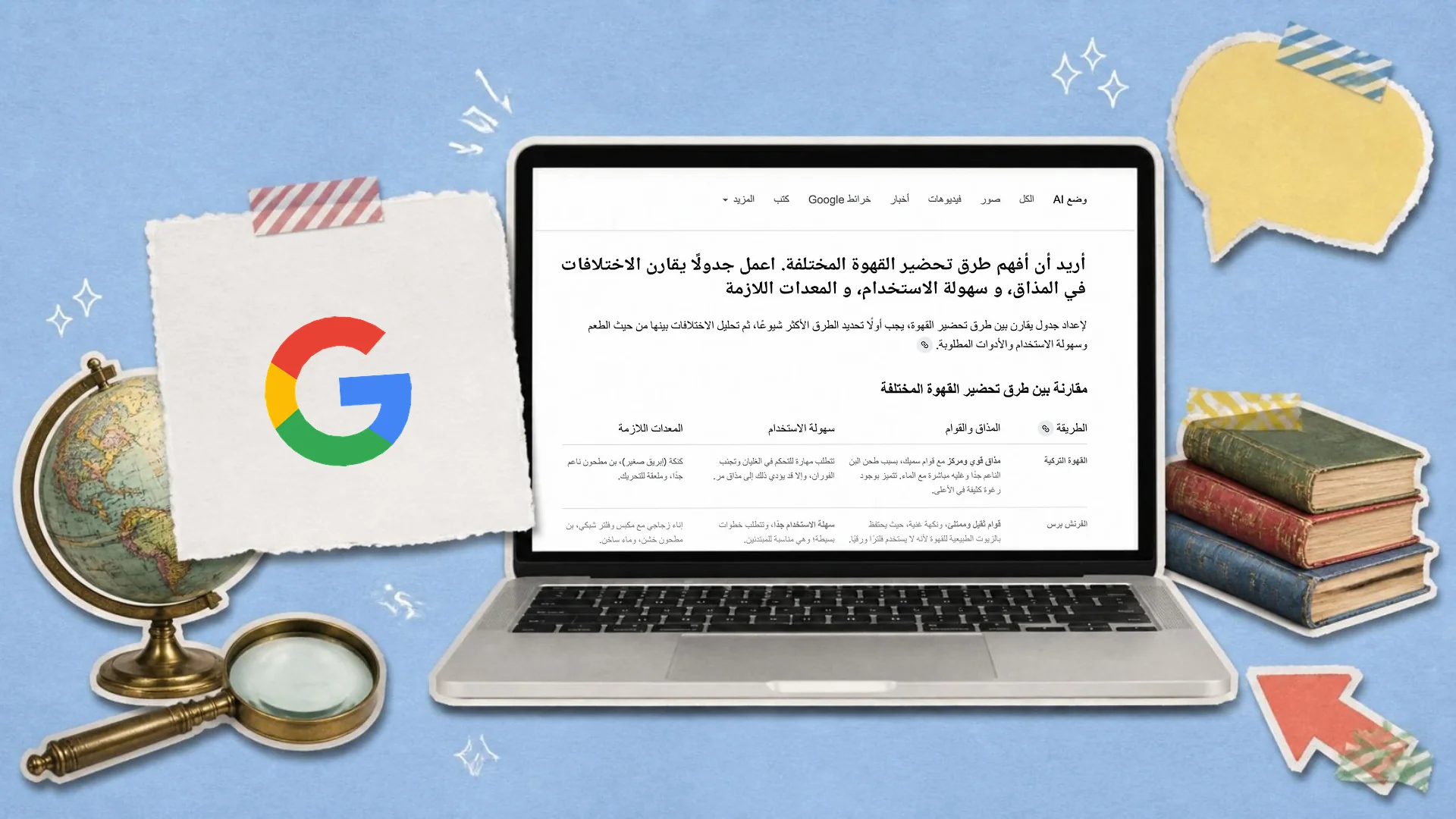
Google's AI Mode, the conversational search tab that answers with an AI-written response and links, started in the US in 2025. It reached the Middle East in English in August 2025 and added Modern Standard Arabic in October 2025, when it expanded to more than 200 countries and territories. In 2026 it grew fast. Google said at its I/O conference in May that AI Mode had more than a billion monthly users and AI Overviews more than 2.5 billion, and in July it described the two as merged into one search experience.
What changed in 2026
- January: Gemini 3 became the default model for AI Overviews worldwide, and people can ask a follow-up from an AI Overview and continue in AI Mode.
- March: Search Live, which lets people search by talking and pointing their camera, became available wherever AI Mode is.
- April: Personal Intelligence, which lets AI Mode use a person's Gmail and Photos with their permission, launched across the Arab world, first for Google AI subscribers.
- May: a redesigned search box that accepts images, files and video, and Gemini 3.5 Flash as AI Mode's default model. Agents that book local services and call businesses on a person's behalf launched in the US only.
- August: some AI Overviews began opening fully expanded, pushing ordinary results further down the page. Google said this happens only where its systems judge it most useful.
Google says AI Mode is not the default search experience anywhere. In June a Google vice president called a test build of Chrome that sent searches to AI Mode an error, and said there were no plans to make it the default. Google has not published AI Mode or AI Overviews figures for the UAE or Saudi Arabia, and its announcements mention Modern Standard Arabic, not Gulf dialects.
How websites appear
In May 2026 Google changed how links appear in AI answers: more links next to the sentence they support, previews with the site name and page title when hovering on desktop, labels on links from a person's news subscriptions, and suggested links to related angles. Later that month it brought Preferred Sources, which lets people choose sites they want to see more of, into AI Overviews and AI Mode, and added a label for articles other publications often cite. Google says people are twice as likely to click a source they have chosen.
What happens to clicks
Google's position is that total organic clicks are relatively stable and that clicks from AI results are of higher quality, and Sundar Pichai said in July that AI features send billions of clicks to websites every week. Google has not published data behind those statements. Independent studies point the other way:
- Pew Research, March 2025: people clicked an ordinary result 8 percent of the time when an AI summary appeared, against 15 percent without one.
- Ahrefs, December 2025 data: the top result's click-through rate was 58 percent lower when an AI Overview appeared.
- Seer Interactive, early 2026: organic click-through with an AI Overview fell sharply through 2025 and partly recovered, and brands cited in the Overview got about 120 percent more clicks than those not cited on the same search.
- SparkToro with Similarweb data, US, January to April 2026: 68 percent of Google searches ended without a click, and AI Mode handled only 0.34 percent of searches.
These figures do not contradict Google's billion monthly AI Mode users: one is monthly users worldwide, the other a share of US searches. What they share is a direction: fewer clicks per search, especially for questions an AI answer can settle.
New tools for site owners
- Search Console's generative AI performance reports show impressions in AI Overviews, AI Mode and AI features in Discover, by page, country and date, with data from 18 May 2026. They show impressions only, not clicks, and reached every site worldwide on 31 August. Clicks from AI features are still counted in the ordinary Performance report.
- A new Search Console setting lets a site keep its content out of AI Overviews, AI Mode and AI in Discover while staying in ordinary results. Google says it is not a ranking signal. It began in the UK, where the competition regulator required it, and went worldwide on 31 August.
- Since August, sites can add a button inviting readers to make them a preferred source.
What to do
- Look at the new AI impressions report for each client's site, and compare it with clicks for the same pages in the Performance report.
- Think carefully before using the opt-out. It keeps content out of AI answers, which is where searches increasingly happen.
- Invest in content an AI answer cannot replace: first-hand experience, original data, local detail, tools.
- Ask loyal readers to add the site as a preferred source.
- Report to clients on visibility and conversions, not only clicks, since clicks per search are falling.
The website traffic checker on this site estimates any site's monthly visits, a quick way to compare a client's traffic with competitors'.