

Most agency owners know their revenue to the dirham and their margin only roughly. That is backwards. Revenue tells you how busy you are; margin tells you whether the business works. This piece sets out the benchmarks worth knowing, what is different in the Gulf, and where the money usually goes.
Measure margin on the right number
Start by taking out pass-through costs: media spend, influencer fees, printing and anything else you buy for a client and bill on. Revenue left after that is what Agency Management Institute calls adjusted gross income, and it is the only fair base for an agency's margins. An agency that bills AED 1 million of which AED 400,000 is ad spend is a AED 600,000 business, and should be judged as one.
- Gross margin: what is left after the cost of delivering the work, mostly the salaries and freelancers on client work.
- Net margin: what is left after everything, including rent, software, visas and the owner's salary.
- Utilisation: the share of paid hours that goes on client work.
What good looks like
There is no published survey of Gulf agency margins, so the best guides come from the UK and the US. BenchPress 2025, from Productive and Bold, found the average gross margin of UK agencies with more than GBP 1 million in revenue fell to 39% in 2024, the lowest it has recorded, against a recommended target of at least 50%. Agency Management Institute's long-used rule of thumb splits adjusted gross income into about 55% for salaries, 25% for overheads and 20% for profit.
Utilisation is where most agencies fall short. Teamwork's State of Agency Operations report, from more than 500 agency leaders, found 52% struggle to get billable utilisation above 50%, and only 18% always hit their targets for billable and non-billable time.
Why the Gulf squeezes sooner
A UAE agency carries costs that a UK agency of the same size does not: visas, medical insurance and end-of-service gratuity on every hire, and Dubai office rents that have risen sharply. Payment is the bigger issue. In a 2021 survey of 30 small and mid-size independent UAE agencies by the Middle East Public Relations Association, 60% said clients do not pay according to the contract, and about 90% said they face price pressure. It is the only Gulf agency payment data published, and few owners would say it has improved.
The six places profit leaks
- Scope creep. Ignition's 2025 report on more than 270 US agencies found nearly 80% rarely or only sometimes charge for out-of-scope work, and more than half lose USD 1,000 to 5,000 a month to it.
- Unbilled time. Agency Management Institute estimates the gap between billable time and time actually invoiced at around USD 40,000 per employee a year.
- Discounts. A 10% discount on a job with a 20% margin halves the profit, and the client remembers the lower price next time.
- Free pitches. Campaign Middle East has written about clients inviting five to ten agencies to pitch for free. Each lost pitch is weeks of senior time.
- Pass-through costs. Media and influencer fees billed at cost make revenue look bigger and margin look smaller. Charge a handling fee or bill them separately.
- Late payment. In the same Ignition report, 97% of agencies deal with late payments and 71% have at least one in four invoices overdue. Money owed is money you are lending.
See it every month
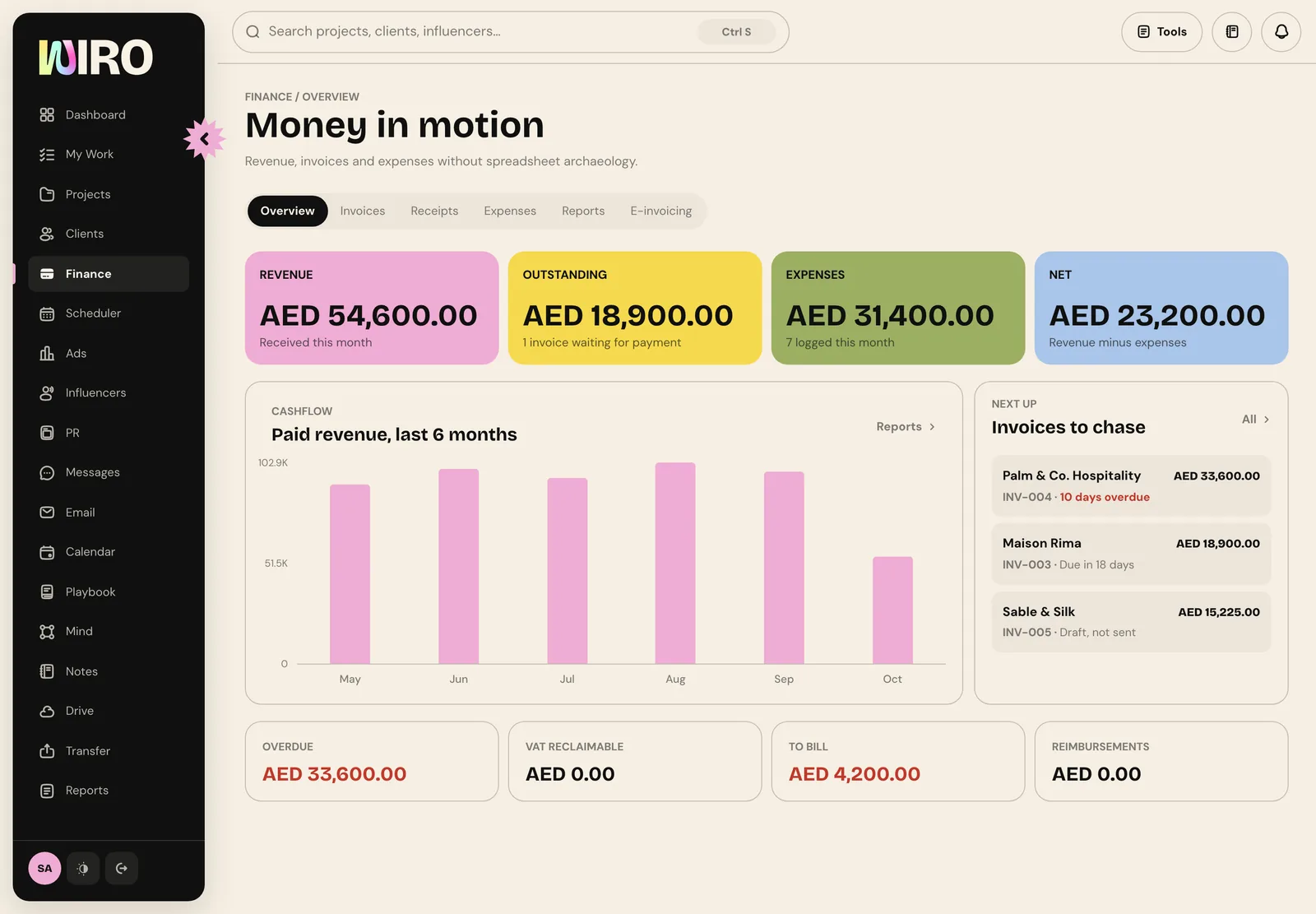
Margin problems are slow and quiet, so look at the numbers monthly, not at year end. In Wiro, Finance, Overview shows what came in this month, what is outstanding, what went out and the net, with six months of cash flow and the invoices to chase. The screens below use a sample agency.
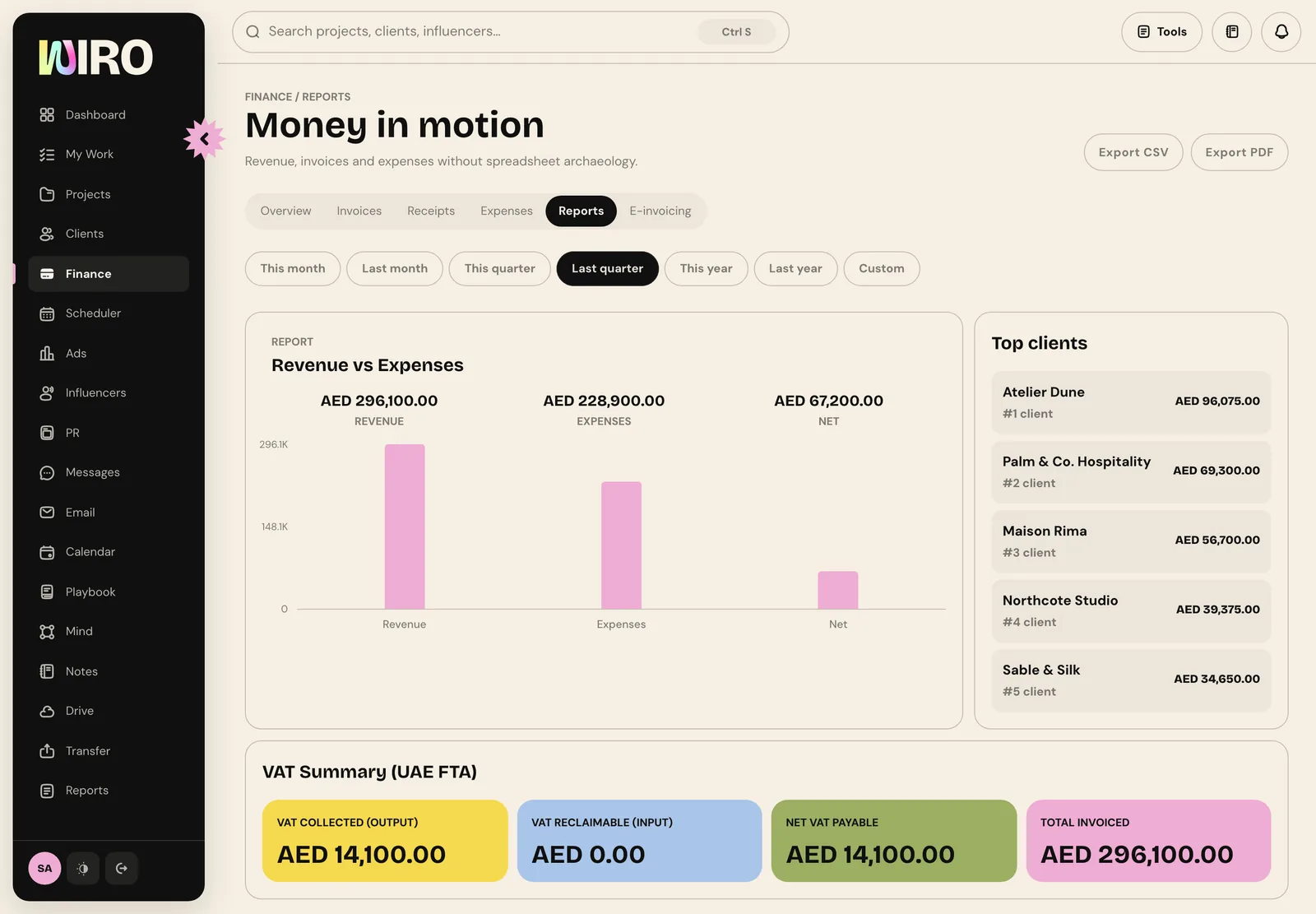
Reports compares revenue with expenses for any period and ranks clients by what they paid. In the sample, last quarter shows AED 296,100 invoiced against AED 228,900 of costs: a thin margin, and a reason to look at which clients carry it.
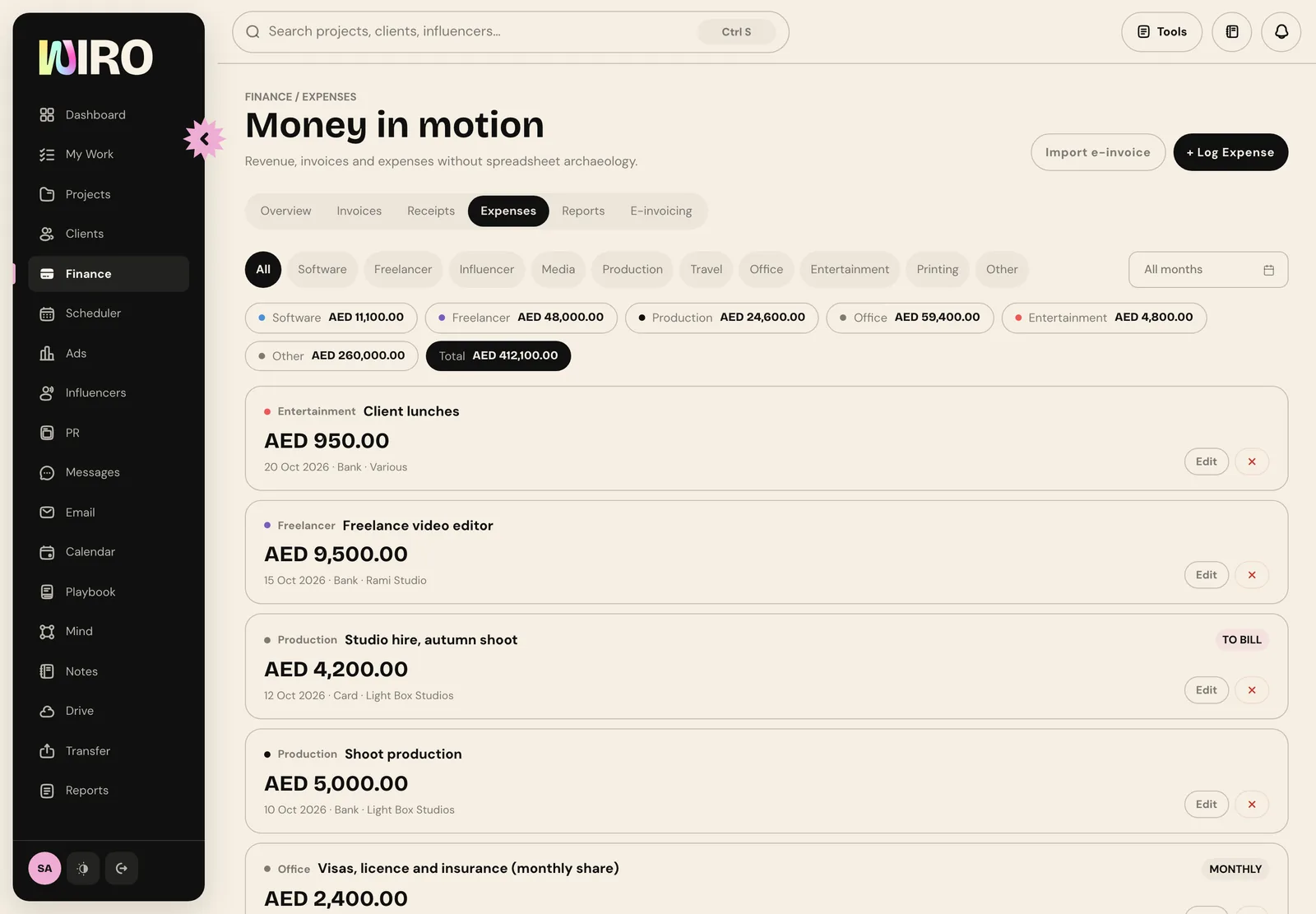
Five fixes that move margin
- Write the scope into every quote and retainer, and price changes before you do them.
- Ask for 50% upfront on projects. Ignition found only 16% of agencies ask for full payment upfront; asking for half is not unusual.
- Invoice on the day the work is delivered, with payment terms on the invoice, and chase on the due date.
- Review each retainer against the hours it really takes, twice a year, and reprice the ones that have grown.
- Stop discounting. Offer less work for less money instead of the same work for less.
Revenue tells you how busy you are. Margin tells you whether the business works.
None of this needs new software or a finance team. It needs the same few numbers, every month, and the discipline to act when one of them moves.